

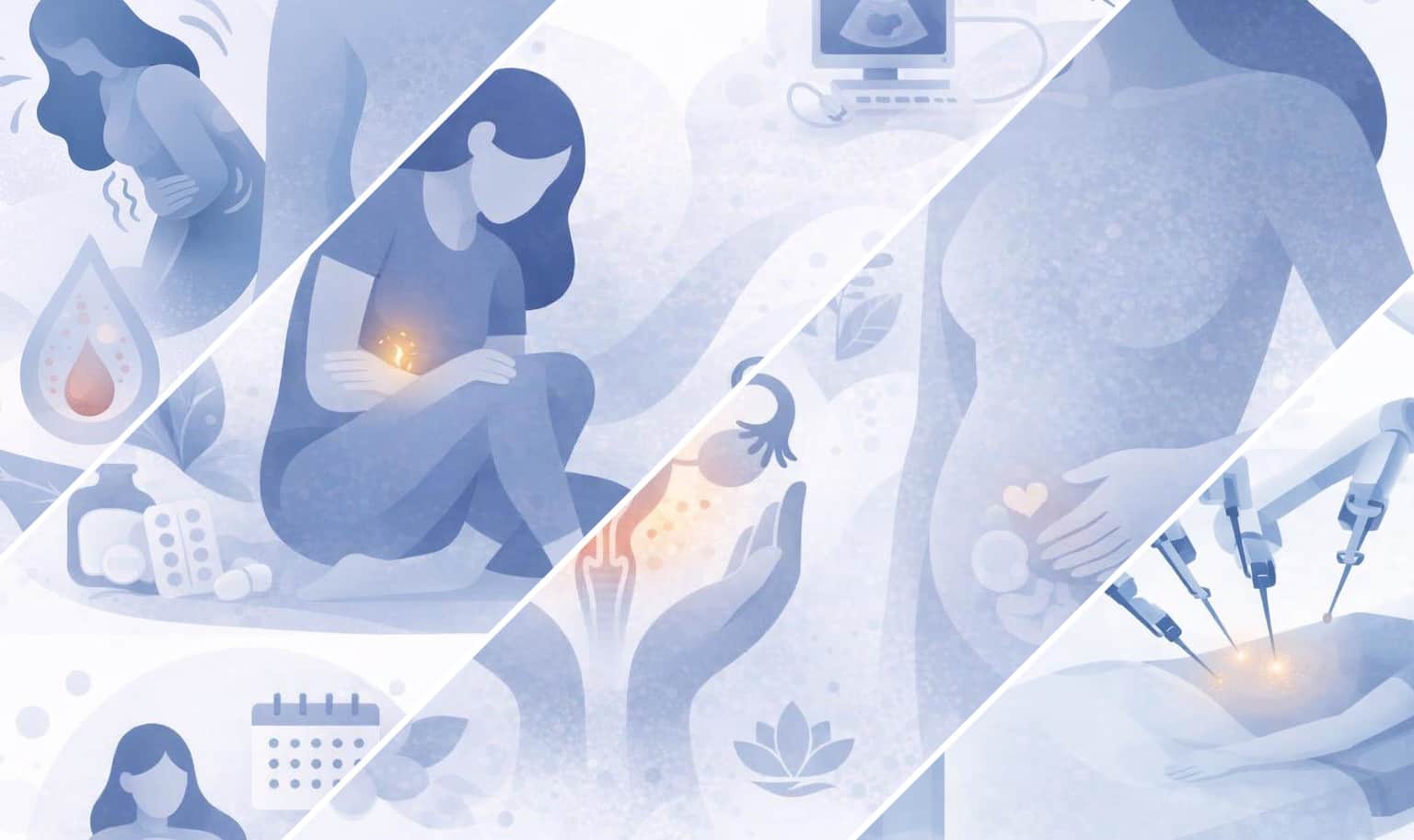
Ovulation Pain
Ovulation pain (mittelschmerz) can be normal—but if it’s severe, cyclical, or disabling, it may be a sign of underlying conditions like endometriosis or adenomyosis. Both can amplify pelvic pain around ovulation through inflammation, adhesions, and nerve sensitization.
Overview
Ovulation pain—often called mittelschmerz—is pelvic pain that occurs around the middle of the menstrual cycle when an ovary releases an egg. Many people feel mild, one-sided twinges that last minutes to a few hours. But when ovulation pain is sharp, intense, lasts longer, or repeatedly disrupts your life, it’s worth considering whether an underlying condition such as endometriosis and/or adenomyosis could be contributing.
In endometriosis, tissue similar to the uterine lining grows outside the uterus—commonly on the ovaries, pelvic sidewall, bowel, bladder, and ligaments. Around ovulation, normal hormonal shifts can increase local inflammation, fluid, and pelvic congestion. If endometriosis lesions, adhesions (scar-like bands), or ovarian endometriomas are present, those “normal” changes can trigger outsized pain—including stabbing ovary pain, deep pelvic aching, or cramping that radiates into the back or legs.
In adenomyosis, endometrial tissue grows within the muscular wall of the uterus. Adenomyosis is classically associated with heavy, painful periods, but many patients also report mid-cycle pain. That can happen because the uterus is more inflamed and reactive overall, and hormonal changes around ovulation can increase uterine cramping and pelvic pressure—especially when adenomyosis co-occurs with endometriosis (a common overlap).
Severe ovulation pain can overlap with other conditions too—such as ovarian cysts, pelvic inflammatory disease, fibroids, GI or urinary conditions, and pelvic floor dysfunction. What often separates endometriosis/adenomyosis-related ovulation pain is the pattern: recurring month after month, often alongside symptoms like painful periods, pain with sex, bowel/bladder pain, bloating, fatigue, or infertility. Because diagnosis can be complex and imaging may miss disease, a specialist evaluation is important—see how we approach this at Evaluation & Diagnosis.
When ovulation pain becomes something you plan your calendar around, it’s not “just normal.” Tracking patterns, getting a thorough evaluation, and finding the right combination of medical, surgical, and integrative care can help you regain predictability and quality of life. For related symptom patterns, you can also explore articles through Posts or use Search.
What It Feels Like
People often describe severe ovulation pain as a sharp, stabbing, or “knife-like” pain on one side of the pelvis, sometimes switching sides from month to month. Others feel a deep ache, heavy pressure, or cramping that spreads across the lower abdomen rather than staying localized. Some notice it as a sudden spike of pain during movement, exercise, coughing, or using the bathroom.
For many patients with endometriosis/adenomyosis, the pain isn’t limited to a brief twinge—it may last hours to several days, and may be followed by lingering soreness or a flare of pelvic tightness. You might also notice bloating, nausea, fatigue, or pain that radiates to the lower back, hips, or thighs. If pelvic floor muscles have become reactive, mid-cycle pain can also be accompanied by a feeling of pelvic “clenching,” urinary urgency, or painful intercourse.
Symptoms can change over time. Some people start with mild mid-cycle discomfort that becomes more intense or longer-lasting, especially if adhesions or endometriomas develop. Others find ovulation pain worsens after stopping hormonal suppression, after childbirth, or during periods of high stress—when inflammation and nervous system sensitivity can amplify pain signals.
How Common Is It?
Mild mittelschmerz is common in the general population, but severe ovulation pain is more often reported by people with underlying pelvic conditions. With endometriosis—which affects about 10% of reproductive-age women—mid-cycle pain can be part of a broader pattern of cyclical pelvic pain, especially when disease involves the ovaries, pelvic ligaments, or deeper tissues.
In adenomyosis, the best-known symptoms are heavy bleeding and painful periods, but many patients also report non-menstrual pelvic pain (including mid-cycle pain), particularly when adenomyosis coexists with endometriosis. Importantly, the severity of pain does not reliably match “stage” of endometriosis; people with minimal visible disease can have severe pain, while others with extensive disease may have less. Location (ovaries, uterosacral ligaments, deep infiltrating areas) and nerve involvement often matter more than stage.
Because ovulation pain is sometimes minimized or labeled “normal,” it may be underreported and under-studied. If you suspect your symptoms fit an endometriosis/adenomyosis pattern, a specialist evaluation can help clarify what’s driving your pain—learn more about our process at Evaluation & Diagnosis.
Causes & Contributing Factors
Around ovulation, follicles grow, the ovary releases an egg, and a small amount of fluid and blood may irritate the pelvis. In someone without underlying disease, that irritation is usually mild. In endometriosis, however, lesions can create a chronic inflammatory environment. Ovulation-related changes can trigger a stronger inflammatory response, leading to swelling, chemical irritation, and pain.
Endometriosis can also cause adhesions that tether the ovary to nearby structures (pelvic sidewall, bowel, uterus). When the ovary enlarges slightly around ovulation or shifts with movement, those tethered tissues can pull—creating sharp, positional pain. If an endometrioma (ovarian cyst caused by endometriosis) is present, the ovary may be more sensitive, and cyst-related stretching or micro-leakage can intensify mid-cycle pain.
In adenomyosis, the uterine muscle is infiltrated by endometrial tissue, which can make the uterus more enlarged, tender, and prostaglandin-driven (cramp-prone). Mid-cycle hormonal shifts may increase uterine contractility and pelvic pressure, contributing to ovulation-time cramping—especially in patients who already have baseline uterine inflammation.
Finally, nerve sensitization plays a major role. Repeated monthly inflammation can “turn up the volume” on pelvic nerves and the pain-processing system, so a normal physiologic event (ovulation) becomes disproportionately painful. Pelvic floor muscle guarding can then worsen the cycle—pain leads to tightness, and tightness leads to more pain.
Treatment Options
Treatment depends on what’s driving your ovulation pain and your goals (symptom relief, fertility, avoiding hormones, etc.). Many patients benefit from a layered plan that addresses inflammation, ovulation triggers, pelvic floor involvement, and any underlying endometriosis/adenomyosis. A comprehensive roadmap often starts with an expert assessment through Evaluation & Diagnosis.
Medical options may include anti-inflammatory medications (taken strategically around ovulation), prescription pain-relief approaches, and treatments that suppress ovulation to reduce cyclic flares. Hormonal options (like continuous combined contraception, progestins, or other ovulation-suppressing therapies) can lessen mid-cycle pain for some people, though they do not remove endometriosis lesions. You can learn more about options and tradeoffs on our Hormonal Therapy and Pain Management pages.
When symptoms suggest underlying disease—especially with ovarian endometriomas, deep disease, or persistent pain despite medication—surgical treatment may be considered. For endometriosis, excision surgery (removing disease at the root) is widely regarded as the gold standard approach, particularly for durable pain relief and for disease that affects organs or causes adhesions. Lotus specializes in advanced minimally invasive excision—see Surgery & Advanced Excision and learn about our surgeon, Dr. Steven Vasilev.
For adenomyosis, treatment may include hormonal therapy, targeted pain control, and (in select cases) uterine-sparing procedures or hysterectomy depending on symptoms and fertility goals. Because adenomyosis and endometriosis frequently overlap, treating one without assessing the other can leave symptoms unresolved—our team evaluates both. Explore care pathways on adenomyosis and endometriosis.
Lifestyle and integrative support can meaningfully reduce flare intensity for some patients: heat, gentle movement, pacing, anti-inflammatory nutrition, sleep optimization, stress-reduction tools, and selected supplements (with clinician guidance). Pelvic floor physical therapy can be especially helpful when pain is accompanied by pelvic tightness, urinary urgency, or pain with sex. See Integrative Medicine & Lifestyle Care for ways we support whole-person recovery alongside medical or surgical care.
When to Seek Help
Seek urgent medical care if ovulation-time pelvic pain is sudden and severe, comes with fever, vomiting you can’t control, fainting, shoulder-tip pain with dizziness, or signs of internal bleeding; or if you suspect pregnancy and have one-sided pain (ectopic pregnancy must be ruled out). Also seek prompt evaluation if pain is accompanied by heavy bleeding, new abdominal swelling, or you’re told you have an ovarian cyst and symptoms are worsening.
Schedule a specialist visit if ovulation pain is recurring month after month, lasts longer than a day, requires missed work/school, or occurs along with painful periods, painful intercourse, bowel/bladder symptoms, or infertility. Endometriosis often takes 7–10 years to be diagnosed, so earlier specialist evaluation can reduce delays and help protect quality of life and fertility.
What to share with your clinician: timing in your cycle, exact location (right/left/midline), duration, triggers (movement, sex, bowel movements), response to medications, and associated symptoms. Bringing a 2–3 month symptom calendar can be powerful. If you’re ready for a deeper evaluation, you can schedule a consultation with Lotus Endometriosis Institute or contact us to discuss next steps, including in-person visits and telehealth options.
Frequently Asked Questions
Why does ovarian cyst pain keep coming back?
Ovarian cyst pain can feel “recurrent” for a few different reasons. Some cysts are functional (they form with ovulation and then resolve), so the pain returns in a similar spot month after month even though it’s not the exact same cyst. In other cases, the cyst itself can come back or persist—especially if it’s an endometrioma (an ovarian cyst caused by endometriosis), which can behave differently than a simple cyst and may be associated with deeper pelvic disease.
Another common reason is that the cyst isn’t the whole story: endometriosis on the pelvic sidewall, uterosacral ligaments, bowel, bladder, or around the ovary can irritate the same nerves and tissues and make it feel like “my cyst is back” when the driver is actually inflammatory disease nearby. Adhesions (scar-like bands) can also tether the ovary and cause recurring pulling or sharp pain, even when imaging doesn’t show a large cyst. If your pain cycles, escalates, returns quickly after a “normal” ultrasound, or keeps recurring despite prior treatment, our team can help you map the pattern, interpret imaging with an endometriosis lens, and decide whether targeted evaluation and—when appropriate—excision surgery is the next best step.
Are ruptured ovarian cysts linked to endometriosis?
Yes—sometimes. People with endometriosis can develop ovarian endometriomas (“chocolate cysts”), and those cysts can leak or rupture and cause sudden, intense pelvic pain and inflammation. Endometriosis can also distort pelvic anatomy and irritate the ovary, which may make cyst-related pain feel more frequent, more severe, or harder to distinguish from an endometriosis flare.
That said, a ruptured ovarian cyst isn’t automatically endometriosis—functional cysts can happen in anyone, and imaging doesn’t always clearly tell what type of cyst ruptured. If you’ve had recurrent “ruptured cyst” episodes, complex cysts, or ongoing pain between events, it’s worth exploring whether an endometrioma or other endometriosis subtype is part of the bigger picture.
Our team can help you sort out what’s most likely based on your symptom pattern, ultrasound/MRI findings, and fertility goals—and when appropriate, discuss options like strategic minimally invasive excision and other ovary-sparing approaches for endometriomas. If you’re looking for clarity after a rupture (or repeat scares), reach out to schedule a consultation so we can map out a plan tailored to you.
How do I know if an ovarian cyst has burst?
A ruptured ovarian cyst often causes a sudden, sharp pain on one side of the lower abdomen or pelvis, sometimes after exercise, sex, or around ovulation. The pain may then shift into a deeper, persistent ache over the next hours, and you can also notice bloating, nausea, or pain that worsens with movement. Some people have light vaginal spotting, but others have no bleeding at all—so the pattern and intensity of the pain matter more than spotting.
Because pelvic pain can have more than one driver (including endometriosis, an endometrioma, torsion, fibroids, or even bladder or bowel conditions), the only way to know for sure is an evaluation that matches your symptoms with imaging and a focused exam. If you’re having severe or escalating pain, dizziness/fainting, shoulder-tip pain, fever, or heavy bleeding, that can signal significant internal bleeding or another urgent problem—and we want you assessed right away. If you’re dealing with recurrent “cyst rupture” episodes or ongoing one-sided pelvic pain, reach out to schedule a consultation with our team so we can look at the whole picture and build a plan that fits your goals.
How is sciatic nerve endometriosis diagnosed?
Sciatic endometriosis is diagnosed by putting the symptom pattern and exam findings together with expert interpretation of imaging—then confirming what’s actually happening when indicated. We start by listening closely to your full story, including whether buttock, back, or leg pain flares around your cycle, how far it radiates, and whether you’ve had numbness/tingling, weakness, gait changes, or foot drop. On exam, we look for findings that map to the sciatic nerve distribution and can include maneuvers such as a straight-leg raise (Lasègue’s test) and assessing for deep tenderness near the sciatic notch.
Lab tests generally don’t diagnose sciatic endometriosis; inflammatory markers (and sometimes CA-125) can be elevated but aren’t specific and don’t prove nerve involvement. MRI is often the most useful imaging tool for suspected endometriosis-related extraspinal sciatica because it may show a lesion along the nerve (commonly near the sciatic notch) or indirect compression/inflammation patterns that can mimic piriformis syndrome. Even with good imaging, results can be subtle—so symptoms outside the uterus/pelvis shouldn’t be dismissed, and the diagnosis often depends on a careful, whole-body differential that also considers look-alike or coexisting causes of sciatica.
If your history and imaging raise concern for sciatic involvement, our team can guide a stepwise evaluation and discuss what confirmation and treatment would look like in your specific case—including when minimally invasive excision is appropriate and how we assess other contributors to persistent pain. If you’re experiencing progressive weakness, walking difficulty, or foot drop, we consider that a higher-stakes presentation and prioritize timely assessment to reduce the risk of long-term nerve injury.
Can pelvic MRI detect nerve endometriosis?
Sometimes—but a pelvic MRI can miss nerve endometriosis, and a normal MRI does not rule it out. MRI is often the most useful imaging tool when symptoms suggest endometriosis affecting or irritating major pelvic nerves (such as the sciatic nerve), because it may show a lesion in or around the nerve, scarring, or indirect compression patterns.
That said, nerve-related symptoms (buttock, hip, low back, or leg pain; tingling; weakness; pain that flares with cycles) can come from several mechanisms, including endometriosis directly involving the nerve or inflammation/scarring in nearby tissues that “sets off” the nerve without a discrete mass visible on imaging. In our evaluation process, we pair expertly interpreted imaging with a detailed symptom timeline and a focused exam, and we also consider other contributors that can overlap with endometriosis pain—like pelvic floor dysfunction, small fiber neuropathy, or central sensitization.
If you’re pursuing an MRI for suspected nerve involvement, the most important next step is making sure your symptoms and the exact nerve distribution are clearly communicated so the study can be tailored and interpreted with that question in mind. If your MRI is negative but your story still fits, our team can help you decide what additional evaluation makes sense and whether surgical planning or other diagnostics are appropriate.
Can alcohol or caffeine worsen endometriosis infertility?
Yes—alcohol and caffeine may matter for some people, but they’re unlikely to be the main driver of endometriosis‑related infertility on their own. Endometriosis can impair fertility through inflammation and immune signaling, effects on egg quality and ovulation (especially with endometriomas), changes in fallopian tube function and pelvic anatomy, and altered uterine receptivity—so the picture is usually multifactorial.
In the research, alcohol and caffeine show up more as potential contributors to hormone metabolism, inflammation, oxidative stress, and sleep/stress physiology than as clear, stand‑alone causes of infertility. That means some patients notice improvement when they reduce or eliminate them, while others see no meaningful change—especially if active disease (like deep endometriosis, tubal involvement, or endometriomas) is the dominant issue. If you’re trying to conceive and wondering what role these exposures might be playing in your case, our team can help you map your symptoms, imaging, ovarian reserve considerations, and prior fertility history to a plan that targets the factors most likely to move the needle.
Do endometriomas affect fertility or ovarian reserve?
Yes—endometriomas can affect fertility and may be associated with a lower ovarian reserve in some patients. They can drive inflammation in and around the ovary, interfere with normal ovulation mechanics, and sometimes reduce how the ovary responds to fertility medications or how straightforward egg retrieval is.
Ovarian reserve can be impacted by the endometrioma itself, and it can also be affected by surgery—especially repeat cyst surgery—because healthy ovarian tissue can be inadvertently removed or the blood supply altered. When we help patients plan next steps, we weigh symptoms and cyst characteristics alongside age, AMH and antral follicle count, prior surgeries, and your timeline for pregnancy. Depending on your goals, options may include monitoring, medical suppression, fertility treatment first, or thoughtfully planned surgery designed to treat disease while prioritizing ovarian function; our team can help you map out the safest path forward.
Why can pain persist after endometriosis surgery or normal imaging?
Pain can persist after surgery or even when imaging looks “normal” because pain isn’t always a direct measure of visible disease. For some patients, the nervous system stays on high alert (central sensitization), and pain signals continue even after the original trigger has been treated. Imaging also has limits—many pain generators, including subtle inflammation, scar tissue, or nerve irritation, may not show up clearly.
Ongoing symptoms can also come from pelvic floor muscle guarding, myofascial trigger points, or overlapping bladder and bowel pain conditions that coexist with endometriosis or adenomyosis. In these situations, relief often comes from a plan that addresses muscles, nerves, and co-conditions—not just lesions alone. Our team can help you sort out the most likely pain drivers and build a targeted recovery plan; if you’re struggling with persistent pain, reach out to schedule a consultation.
Related Symptoms
Related Articles

Endometriosis Ovulation Pain: Impact and Relief Tips
Learn what ovulation pain feels like with endometriosis, how long it lasts, common symptoms like nausea and mittelschmerz, and evidence-based coping strategies.
Relugolix for Endometriosis Pain: What a 2025 Meta-Analysis Says About Relief, Quality of Life, and Side Effects
2025 meta-analysis of relugolix for endometriosis: pain relief, QoL gains, side effects and add-back therapy, plus comparison with leuprorelin.
Dienogest vs. Combined Oral Contraceptives for Endometriosis Pain: What a 2025 Meta-Analysis Found
A 2025 meta-analysis of dienogest vs OCPs for endometriosis pain: dienogest helps generalized pain; OCPs help pelvic pain/dyspareunia. Similar side effects.
Different Types of Endometriosis Pain Explained
Explore types of endometriosis pain, evaluation, and evidence-based treatments, including triggers, pelvic floor therapy, CNS sensitization, and adenomyosis.
Supportive Therapies That Help Ease Endometriosis Pain
Endometriosis pain relief with supportive, integrative therapies: diagnosis, medical and hormonal care, surgery's role, nutrigenomic and epigenetic insights.
Experiencing Ovulation Pain?
If you're dealing with this symptom, our specialists can help determine if endometriosis may be the cause and discuss your treatment options.
Schedule a Consultation