


Surgery and IVF: When Are They Right for Endometriosis?
Explore when surgery or IVF is best for endometriosis. Understand the decision-making process and what to consider for fertility and health.
11 minute read
Read moreDiscover how Lotus can guide you toward lasting relief.
Explore why patients choose Lotus
Search expert-written answers, browse by topic, or find information based on where you are in your journey.
Explore All KnowledgeReach out and start your healing journey.
Schedule an AppointmentEvidence-based guidance on assisted reproduction for endometriosis—when to choose IVF, expected outcomes, protocol options, impacts on egg/embryo quality, and strategies to optimize success, safety, and time to pregnancy.
Assisted reproduction can be a strategic option when endometriosis affects fertility. IVF helps bypass pelvic inflammation, tubal scarring, or ovulatory disruption and can shorten time to pregnancy compared with expectant management or repeated IUI in many scenarios. Guidance focuses on choosing IVF versus surgery-first or combined pathways based on age, ovarian reserve, disease pattern, endometriomas, and male factor findings.
Content explains realistic success rates, egg and embryo quality considerations, and protocol choices that prioritize safety and pain control. Topics include antagonist or progestin‑primed stimulation, letrozole use, GnRH‑agonist triggers to limit OHSS, whether to remove endometriomas before retrieval, infection prevention, and when to choose freeze‑all, ICSI, or PGT‑A. For adenomyosis, practical pretreatment and transfer strategies to improve implantation are summarized and linked to Fertility Considerations. It also covers managing symptom flares during stimulation with support from Pain Relief. For workup and timing decisions see Infertility, and for surgical planning see Endometriomas and Excision Surgery.
Yes—IVF can be done while you’re still breastfeeding in some situations, but it usually isn’t as simple as “go ahead and start.” Breastfeeding shifts hormones (especially prolactin) and can suppress ovulation, which may affect baseline testing, medication response, and cycle scheduling. Many fertility clinics prefer you to be fully weaned before ovarian stimulation and egg retrieval, both for medication-safety reasons and to make your cycle more predictable.
Endometriosis adds an extra layer: IVF protocols can temporarily raise estrogen, and some patients worry that stimulation will “feed” endometriosis or flare pain. For many people, IVF does not appear to cause dramatic short-term progression, but if you have significant symptoms or deep disease, stimulation planning matters—and symptom control during fertility treatment becomes part of the strategy, not an afterthought. If you’re trying to balance breastfeeding, fertility goals, and endometriosis pain, reach out to our team; we can review your history and help you think through timing, whether surgery has a role, and how to coordinate with your fertility clinic in a way that protects both your quality of life and your pregnancy goals.
Yes—endometriosis can be one contributing factor in recurrent implantation failure (RIF) for some IVF patients. Beyond pelvic anatomy, endometriosis can create an inflammatory environment and may alter how the uterine lining functions, including changes in endometrial receptivity signals that support embryo attachment and early development.
At the same time, RIF is rarely explained by a single diagnosis, and many people with endometriosis still have successful IVF outcomes—especially when endometriosis is the only identified fertility factor. If you’re experiencing repeated failed transfers, the key is a careful, coordinated evaluation of endometriosis biology and severity alongside other common drivers of RIF, so we’re not missing treatable contributors.
Our team can help you look at the whole picture—symptoms, imaging, prior IVF response, history of endometriomas or pelvic adhesions, and any signs of adenomyosis or uterine factors—then discuss whether excision surgery, timing, or other strategy adjustments may improve the chances of implantation in future cycles. If you’d like, reach out to schedule a consultation so we can map a plan tailored to your fertility goals and your timeline.
For many patients, egg retrieval and the IVF stimulation that comes with it do not appear to dramatically “accelerate” endometriosis in the short term—even though estrogen levels can rise significantly during stimulation. That said, it’s common to feel worse temporarily: ovarian enlargement, inflammation, and pelvic pressure can trigger pain flares, and symptoms may feel more noticeable once you’ve been off hormonal suppression to pursue pregnancy.
The main caveat we take seriously is deep infiltrating endometriosis and patients with significant baseline symptoms, where limited data suggest stimulation may contribute to progression in some cases. In real life, the decision is often a balance: IVF may help you move toward pregnancy sooner and reduce the total time you’re off symptom-controlling therapy, but the plan should be individualized around your disease pattern, endometriomas, prior surgeries, and quality-of-life goals. If you’re weighing egg retrieval and worried about symptom escalation, our team can help you think through timing, coordination with fertility care, and whether treating endometriosis surgically first (or after retrieval) makes the most sense for your body and timeline.
Yes—an ovarian endometrioma can rupture during ovarian stimulation, although it’s not the most common outcome. Stimulation can enlarge the ovaries and increase pressure within the pelvis, and an endometrioma is a fluid-filled cyst that can be sensitive to stretching, inflammation, or mechanical stress. If a rupture happens, people often describe a sudden, sharp one-sided pelvic pain that may be very different from their usual “endo pain.”
Because several urgent problems can look similar during stimulation (like ovarian torsion, bleeding, or infection), the key is not to guess the cause based on symptoms alone. Our team can help you sort out what’s most likely in your situation using a careful history and targeted imaging—especially ultrasound and, when helpful, expertly interpreted MRI—so you know whether you’re dealing with an endometrioma complication or something else.
If you’re planning IVF or are already in a cycle and you have a known endometrioma, it’s worth proactively mapping out a plan for monitoring and next steps if pain escalates. We can also walk you through fertility-conscious options that may be appropriate for selected patients, including less invasive approaches when the goal is protecting ovarian tissue while still reducing endometrioma-related risk and symptoms.
Yes—when a true hydrosalpinx is present, removing or otherwise disconnecting the affected tube before embryo transfer is often recommended because the inflammatory fluid can reflux into the uterus and interfere with implantation. In people with endometriosis, a hydrosalpinx also commonly signals broader pelvic inflammation, scarring, or adhesions, so addressing it can be a meaningful way to reduce a “second factor” that may be lowering IVF odds.
The right approach depends on your anatomy and goals: sometimes this is a minimally invasive salpingectomy (tube removal), and in other cases a proximal tubal occlusion is considered to block the fluid from reaching the uterine cavity. If endometriosis is also driving pain or distorting pelvic anatomy, we often plan surgery in a coordinated way—treating endometriosis and the tube issue in the same setting when it’s safe and appropriate—so you can recover efficiently and move on to fertility treatment.
If you’ve been told you have a hydrosalpinx, our team can review your imaging and fertility history, confirm the diagnosis (hydrosalpinx can be confused with other cystic findings), and help you map out a timeline that balances symptom relief, surgical complexity, and your IVF plans.
Letrozole during ovarian stimulation is sometimes used in IVF protocols to blunt estrogen levels compared with a standard stimulation, because it blocks aromatase (the enzyme that helps your body make estrogen). Since endometriosis is often estrogen-responsive, keeping estrogen from climbing quite as high may help some patients feel more stable symptom-wise during a cycle, and it can be a useful tool when we’re trying to balance fertility goals with quality of life.
That said, letrozole is not a treatment that “heals” endometriosis. At best, it can help manage the hormonal environment during a short window; it doesn’t remove disease, reverse scarring, or correct the underlying inflammation and nerve involvement that drive many symptoms. If you’re considering IVF and worried about flare-ups or progression—especially if you suspect deep disease—our team can help you think through the right sequence (medical suppression vs. IVF timing vs. excision when appropriate) and how protocol choices like letrozole fit into your bigger plan.
Lupron (a GnRH agonist) before a frozen embryo transfer is sometimes used to “quiet” endometriosis activity by deeply suppressing estrogen for a short period of time. For some patients—especially those with significant symptoms, suspected active inflammation, adenomyosis, or prior transfer failures—this kind of suppression can be part of an IVF plan aimed at improving the uterine/pelvic environment before transfer. The trade-off is that Lupron doesn’t remove endometriosis lesions or “cure” the disease; it’s symptom- and activity-suppressing, and symptoms commonly return after stopping.
The decision is very individual because the downsides can be real: hot flashes, sleep disruption, mood changes, vaginal dryness, and bone density effects (which is why these medications are typically used only short-term, sometimes with add-back therapy). If you’re considering Lupron specifically as a bridge to embryo transfer, it’s worth zooming out and looking at the bigger strategy—whether you may benefit more from addressing disease at its root (often via expert excision, when appropriate), versus proceeding with a time-limited suppression approach to optimize timing for transfer. Our team can help you weigh your endometriosis history, imaging, symptoms, and fertility timeline so your plan supports both pregnancy goals and long-term health—reach out to schedule a consultation if you’d like us to review your case.
It depends—removing an endometrioma before IVF can help in some situations, but it can also reduce ovarian reserve if healthy ovarian tissue is damaged during cyst removal. The key question is what the endometrioma is doing right now: is it primarily a space-occupying cyst that’s interfering with access to follicles during retrieval, causing significant pain, or raising concern for another diagnosis, versus a stable cyst where the main priority is protecting egg yield.
In fertility planning, we often look beyond a single AMH number and pay close attention to ultrasound follicle counts (AFC) in each ovary, especially if the cyst is one-sided or large—because that “local” impact can guide whether to proceed straight to IVF or address the cyst first. For patients who want a less invasive option aimed at preserving ovarian tissue, ethanol sclerotherapy may be worth considering; it can shrink the cyst without cutting it out, though recurrence risk can be higher and technique matters.
If you’re deciding between IVF now versus treating the endometrioma first, our team can review your imaging, cyst size and behavior over time, AFC per ovary, pain history, and IVF goals to map out the most fertility-protective sequence. You can also explore our resources on endometriomas, ovarian reserve testing, and fertility-focused treatment options, then reach out to schedule a consultation so we can personalize the plan.
Explore when surgery or IVF is best for endometriosis. Understand the decision-making process and what to consider for fertility and health.
Explore how GLP-1 medications affect oral contraceptive effectiveness for endometriosis and adenomyosis patients. Get informed now!
Discover how to navigate pregnancy with endometriosis while managing symptoms. Explore safe options and recent research on fertility and treatment.
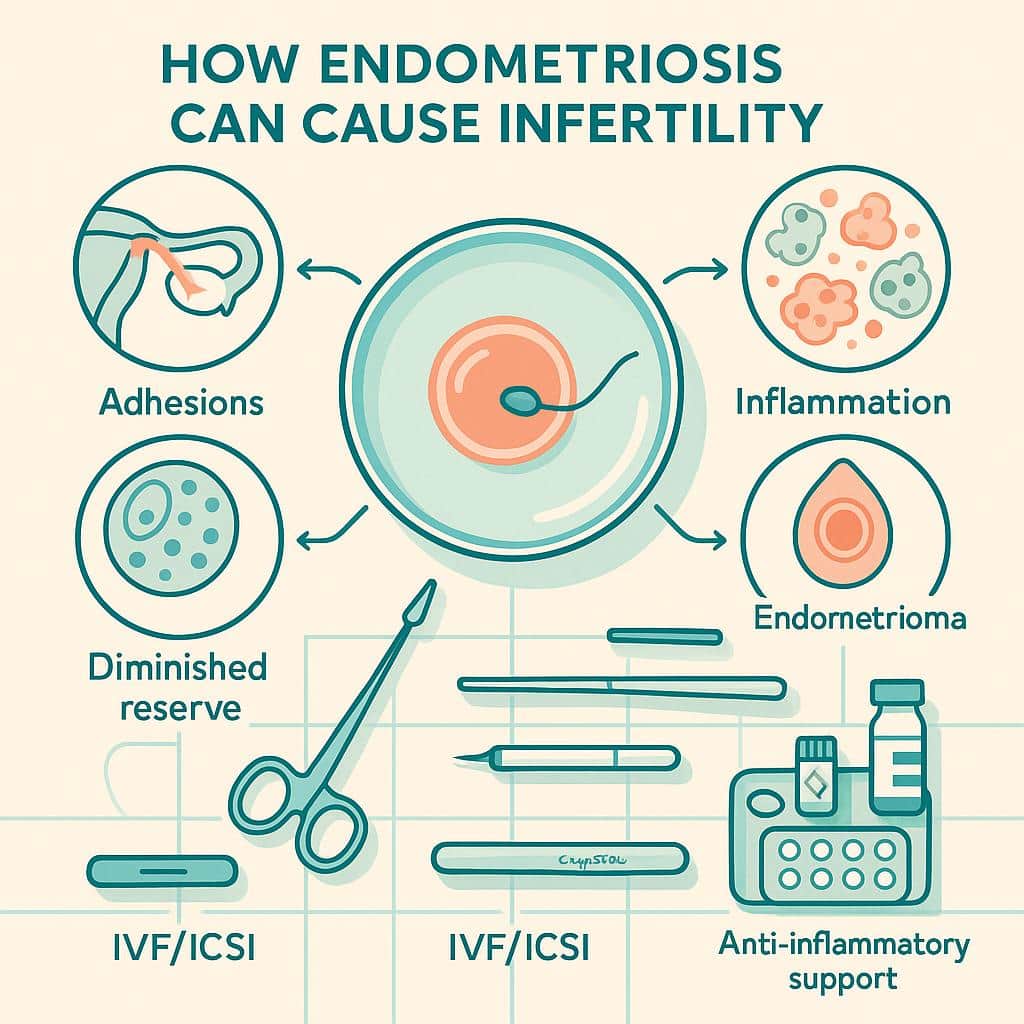
How endometriosis leads to infertility: pathogenesis; effects on gametes, tubes, and endometrium; and treatments—expectant care, surgery, and ART.
Lotus Endometriosis Institute provides California-based surgical evaluation and advanced excision care for patients with suspected endometriosis, adenomyosis, complex pelvic pain, and related conditions.
Many patients contact us from outside California to learn whether traveling for in-person evaluation and possible surgery may be appropriate.
2121 Santa Monica Blvd, Santa Monica, CA 90404
8am - 5pm
Monday - Friday
154 Traffic Way, Arroyo Grande, CA 93420