

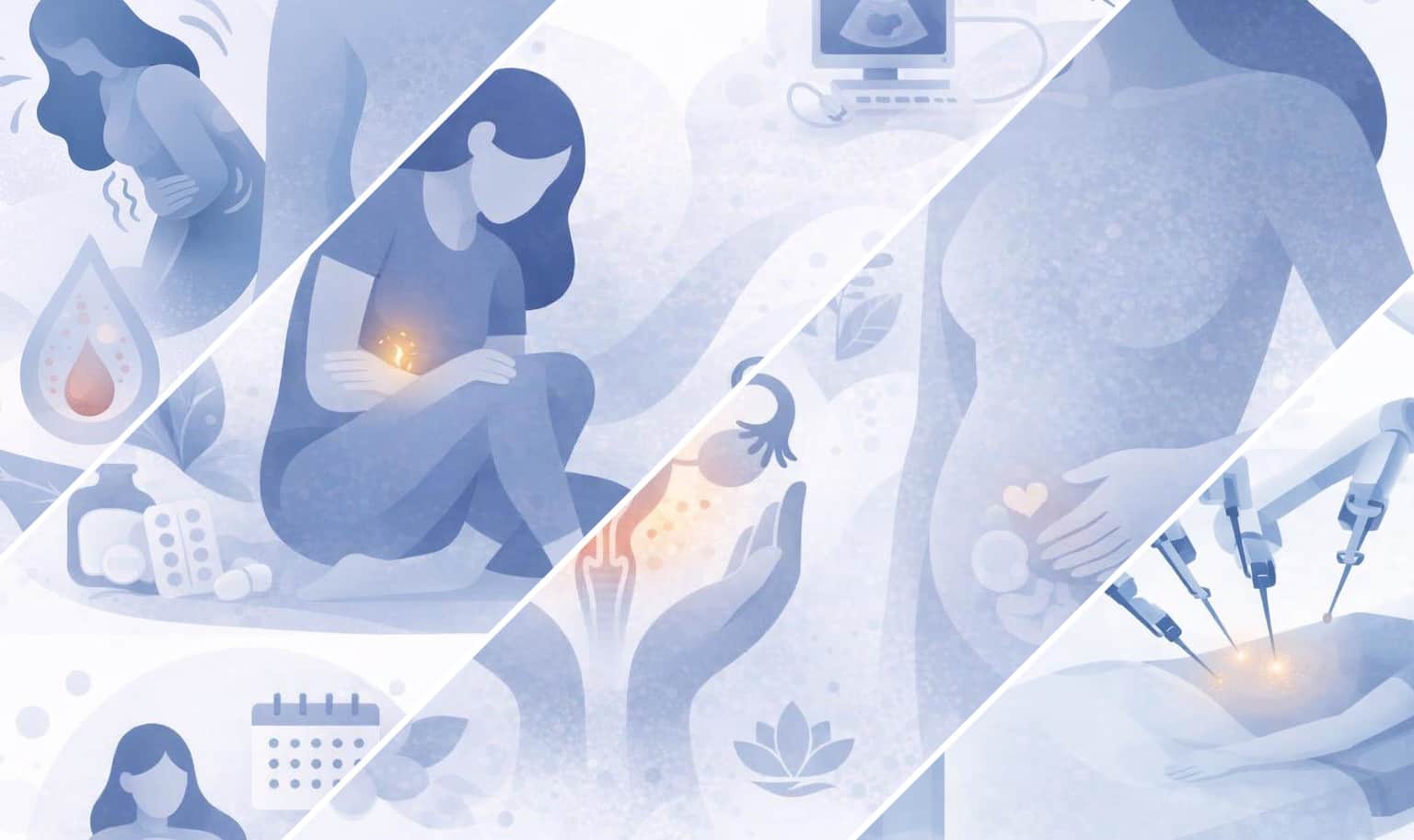

Trying to Conceive With Endometriosis Without Making Symptoms Explode
How to weigh natural attempts, IVF, and the real risk of progression
If you’re living with endometriosis and you want a baby, you’re often forced into an unfair trade-off: the treatments that help you function day-to-day (hormonal suppression) are the same treatments that block ovulation and make pregnancy impossible. When you stop them to try, pain can return, bleeding can worsen, and the fear of “making the disease grow” can feel constant.
Then there’s IVF related treatments. You may have heard some of these “feed endometriosis” because stimulation raises estrogen. That idea can be terrifying—especially if you’ve already had surgery, have deep disease, or finally got your symptoms under control.
Recent evidence gives a more practical way to think about this decision: for many people, IVF does not seem to dramatically accelerate endometriosis in the short term, but there are caveats—especially if you have deep infiltrating endometriosis or significant symptoms. The goal is to choose the path that maximizes your chance of pregnancy without sacrificing your quality of life more than necessary.
The core problem: what helps endometriosis usually prevents pregnancy
Most medical management for endometriosis works by creating a steady hormonal environment—typically suppressing ovulation and periods. That’s why it often reduces pain and helps reduce recurrence after surgery. But it also means:
- If you’re trying to conceive naturally, you can’t stay on the hormones that keep symptoms controlled.
- When you stop suppression, symptoms often return, and some people will have recurrence or progression over time.
This isn’t a personal failure or “your body betraying you.” It’s the predictable downside of a treatment strategy that works best when it’s continuous.
Option 1: Trying naturally — when “taking a break” from treatment makes sense
If your doctor recommends stopping hormonal therapy to try naturally, the usual real-world issue is time. Infertility is generally diagnosed after about 12 months of trying (sooner if you’re older or have other factors). That can mean up to a year off symptom-controlling medication—sometimes longer if testing and referrals drag on.
That time off therapy can be clinically reasonable only if your chances of natural pregnancy are realistically good. Otherwise, you may pay a high price in pain and disease activity while losing valuable time—especially if age or ovarian reserve are concerns.
What “reasonable chances” often depends on your specific situation: your age, prior surgeries, ovarian reserve, partner sperm factors, tubal status, and whether you have endometriomas or deep disease. The key point is that “try naturally for a year” shouldn’t be an automatic script. It should be a deliberate decision. A consult with a reproductive endocrinologist (REI) may help you determine reality and likelihood of various paths.
Option 2: IVF — does ovarian stimulation actually worsen endometriosis?
IVF stimulation can raise estrogen dramatically—up to around 10× a natural cycle. That sounds like it should worsen endometriosis. But the most patient-relevant takeaway from the current evidence is this: for many women, IVF does not appear to cause major short-term progression.
However, there’s an important exception to keep on your radar: limited data suggest ovarian stimulation may promote progression in some cases of deep infiltrating endometriosis. That doesn’t mean IVF is “dangerous” or off-limits. It means you and your team should take deep disease seriously when planning stimulation and follow-up, rather than assuming risk is zero.
If you’re weighing IVF because you’ve already been trying, you’re older, or you have known infertility factors, the potential benefit is clear: IVF may shorten the amount of time you’re off symptom-controlling therapy and increase pregnancy chances sooner—potentially reducing the window where symptoms can flare unchecked.
Protect Your Fertility Without Pain
Our specialists are here to help you understand your condition and explore your treatment options.
Schedule Your ConsultationThe decision isn’t only about endometriosis—pregnancy itself can be higher-risk
Another layer that often gets missed in fertility conversations: endometriosis is linked with a higher risk of some serious pregnancy complications. The review highlights that these risks may vary depending on whether conception is natural or assisted (the details and mechanisms aren’t fully settled). For you, the practical implication is:
If you do become pregnant—either way—it’s reasonable to ask for appropriately attentive prenatal care, especially if you have deep disease, prior uterine surgery, adenomyosis, or a history of severe symptoms.
How to choose between natural attempts and IVF (without guessing)
A helpful way to frame this isn’t “Which choice is safer?” but “Which choice gives me the best chance of a healthy pregnancy while protecting my daily functioning?”
Natural attempts may fit best if your pain is manageable off hormones, your fertility odds are good, and you’re unlikely to lose crucial time. IVF may fit best if time matters (age/ovarian reserve), if you’ve already tried, if you have known infertility factors, or if being off suppression is predictably brutal for your symptoms.
Just as important: your plan doesn’t have to be all-or-nothing. Some people do a time-limited natural attempt and switch to IVF quickly if it isn’t working. Others choose IVF earlier to reduce months of uncontrolled symptoms. The “right” answer is the one that reflects both your medical reality and your quality of life.
What you can realistically expect symptom-wise
Stopping hormonal suppression commonly means symptoms return—sometimes within weeks, sometimes more gradually. While the evidence doesn’t promise an exact timeline, you deserve a plan for what happens if pain spikes.
In practice, many patients do best when they decide in advance:
- how long they’re willing to tolerate worsening symptoms before changing course,
- what “failure to progress” looks like (no pregnancy by X months, worsening pain, enlarging endometrioma, etc.),
- and what the next step will be (expedited fertility care, IVF REI consult, surgery evaluation, etc.).
Practical takeaways: questions to ask your doctor
- “Given my age, ovarian reserve, and partner factors, what are my realistic odds of pregnancy in the next 3–6 months naturally?”
- “If I stop hormones to try, what symptoms or imaging changes would make you recommend switching plans sooner?”
- “Do I have deep infiltrating endometriosis? If yes, does that change your IVF stimulation approach or monitoring?”
- “How will we monitor for progression—symptoms only, ultrasound/MRI, or both?”
- “If IVF is recommended, can we discuss protocols that may help reduce symptom flares, and what pain control options are safe while trying?”
Watch-outs and red flags while trying
If you’re off suppression and trying to conceive, don’t ignore rapid changes. Contact your clinician promptly if you develop rapidly worsening pelvic pain, bowel symptoms that are new or escalating, fainting/severe dizziness with bleeding, fever, or sudden severe one-sided pain (especially if you have an endometrioma). Even when endometriosis is the likely culprit, these symptoms can overlap with urgent conditions that deserve quick assessment.
Reality check: what we still don’t know
This area has real uncertainty. Not everyone’s endometriosis behaves the same way, and “progression” can mean different things (symptoms, imaging changes, surgical findings). The current evidence is overall reassuring about IVF and progression for many patients, but the signal about possible deep disease progression in some cases means your individual anatomy matters.
Most importantly: you don’t have to accept a plan that requires you to suffer for a year “just to prove infertility” if your chances are low or your symptoms are severe. Your quality of life is a legitimate medical priority—especially when time matters for fertility. It is very prudent to get help with your decisions. These consultants may include an endometriosis specialist and an REI specialist.
References
Somigliana E, Viganò P, Invernici A, Fornelli G, Merli I, Vercellini P. Risk of endometriosis progression in infertile women trying to conceive naturally or using IVF. Human Reproduction (Oxford, England). 2025.. DOI: 10.1080/14647273.2025.2610586
Quick Answers
Can endometriosis cause infertility and pelvic pain in your 20s?
Yes, endometriosis can cause chronic pelvic pain and fertility challenges in your late 20s. Pain can include severe period cramps, pain with sex, and bowel or bladder pain, though symptom severity doesn’t always match how much disease is present.
What does advanced adenomyosis mean?
Advanced adenomyosis usually means more extensive disease within the uterine muscle, often affecting a larger area or reaching deeper into the wall. There is no universally accepted staging system, and adenomyosis does not spread outside the uterus.
Why do endometriosis doctors focus so much on fertility?
Many doctors focus on fertility because endometriosis can affect it, and fertility is time-sensitive. But fertility should never be the only focus: pain, bowel and bladder symptoms, fatigue, and quality of life matter whether or not pregnancy is a goal.
Is endometriosis surgery only for fertility?
No, endometriosis surgery is not only for fertility. Excision surgery is often performed to relieve pain and other symptoms, restore normal anatomy, or address endometriosis affecting organs like the bowel or bladder. Surgery can also help confirm the diagnosis.