Surgery
Is simple laparoscopy enough for endometriosis surgery?
The short answer
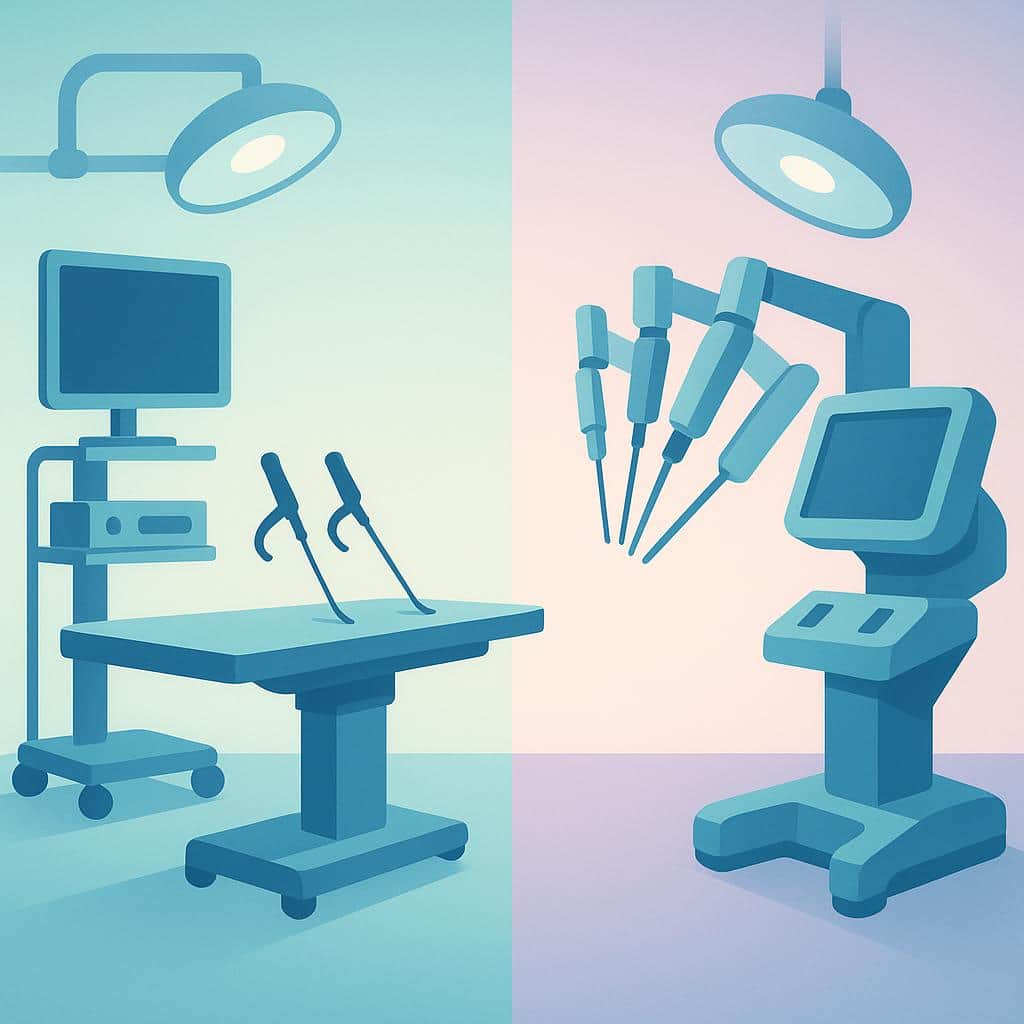
In experienced hands, standard (non-robotic) laparoscopy can be enough to treat endometriosis, especially when disease is limited. The key is the surgeon’s ability to fully identify and safely remove disease; robotic assistance can offer advantages in complex cases.
In experienced hands, standard (non-robotic) laparoscopy can be enough to treat endometriosis, especially when disease is limited and lesions are straightforward to access and remove. What matters is less the tool itself than the surgeon’s ability to fully identify and safely excise disease.
For more advanced or complex endometriosis, however, a robotically assisted minimally invasive approach can offer advantages, including finer instrument control and enhanced visualization in tight spaces. These capabilities can matter when endometriosis involves deeper tissue planes or requires meticulous dissection around sensitive structures. If you’re deciding between approaches, our team can review your symptoms, imaging, and prior operative findings and help you understand which technique best fits your situation.
Where to go from here
Understand it, compare it with what you're feeling, then talk it through with us.
Understand
Understand the condition
Compare
Symptoms it can relate to
Speak with Us
Need Expert Endometriosis Surgery?
Our specialists determine the best surgical approach for your unique case, ensuring precise removal of endometriosis. Trust our skilled surgeons to provide safe, effective treatment tailored to your needs.
Questions people ask next
All surgery questionsIs robotic surgery safe?
Yes, robot-assisted surgery is considered safe when performed by an experienced surgical team. The robot does not operate independently; your surgeon fully controls every movement in real time. It may help improve precision in complex pelvic surgery.
Should I see a gyn, MIGS surgeon, or excision specialist for endometriosis?
A general gynecologist may be a reasonable starting point for routine evaluation or medication, while an excision specialist is usually the most direct path for suspected complex disease. MIGS training alone does not automatically mean deep endometriosis excision expertise.
Who is a good candidate for robotic endometriosis surgery?
Robotic surgery can be a good fit when complex, deep endometriosis is anticipated or disease may involve the bowel, bladder, or ureters. Candidacy is individualized, based on disease mapping, surgical goals, and which approach allows thorough, safe removal.
Benefits of minimally invasive/robotic surgery for endometriosis?
Minimally invasive and robotic surgery can mean less pain, less blood loss, and a smoother early recovery compared with larger-incision surgery. Enhanced visualization and precise instrument control can help remove endometriosis while minimizing unnecessary tissue trauma.
Further reading
Conventional Laparoscopy vs Robotic Surgery for Endometriosis and Adenomyosis: What Patients Need to Know
Comparing safety, effectiveness, and recovery: a patient-friendly overview of different surgery approaches and what they can mean for your treatment.
Excision vs Ablation: Understanding Endometriosis Surgery Options
Explore excision vs ablation for endometriosis. Learn about surgery options, pain relief, and making informed choices based on your fertility goals.
How to Choose a True Endometriosis Excision Specialist
Finding a skilled endometriosis excision surgeon can be challenging. Learn how to choose the right specialist and navigate financial options with confidence.