Fertility
What should a fertility workup include with endometriosis?
The short answer
A fertility workup with endometriosis typically looks at egg supply and pelvic anatomy, with ovarian reserve tests, pelvic ultrasound and commonly a partner's semen analysis. Depending on your history and imaging, it may include tests to see if the fallopian tubes are open, and sometimes MRI.
A fertility workup for someone with endometriosis typically looks at both egg supply and pelvic anatomy, because endometriosis can affect ovulation, the ovaries, tubes, and the pelvic environment. We often start with ovarian reserve testing (such as AMH bloodwork and an antral follicle count on ultrasound) and a pelvic ultrasound to evaluate the uterus and ovaries, including whether endometriomas or signs of adenomyosis may be present.
Depending on your history and imaging, additional testing may include tubal patency evaluation to see whether the fallopian tubes are open, and sometimes MRI for more detailed mapping of suspected disease before we plan next steps. A complete workup also commonly includes a semen analysis for the partner, since male-factor issues are common and can change the plan quickly. The goal is to use these results to match you with the most efficient path (timed intercourse, IUI, fertility treatment, and/or surgical evaluation when anatomy affected by endometriosis is likely a barrier). Our team can help you interpret the findings and decide what makes sense for your timeline.
Where to go from here
Understand it, compare it with what you're feeling, then talk it through with us.
Speak with Us
Worried About Fertility and Endometriosis?
Our specialists understand how endometriosis can impact your fertility. We offer thorough evaluations to assess egg supply and pelvic health to guide your treatment options.
Questions people ask next
All fertility questionsHow is infertility from endometriosis treated?
Treatment depends on how endometriosis is affecting your fertility. Excision surgery can remove disease and restore anatomy when fertility is physically blocked. Fertility treatment is sometimes the next step after surgery and sometimes the first step.
What should I ask about endometriosis-related infertility?
Ask for a plan that specifically evaluates endometriosis or adenomyosis, including imaging, whether your tubes are open, and ovarian reserve. Ask how treatments affect your timeline, when an excision-focused surgical evaluation makes sense, and how pain care can support your fertility goals.
Do endometriomas affect fertility or ovarian reserve?
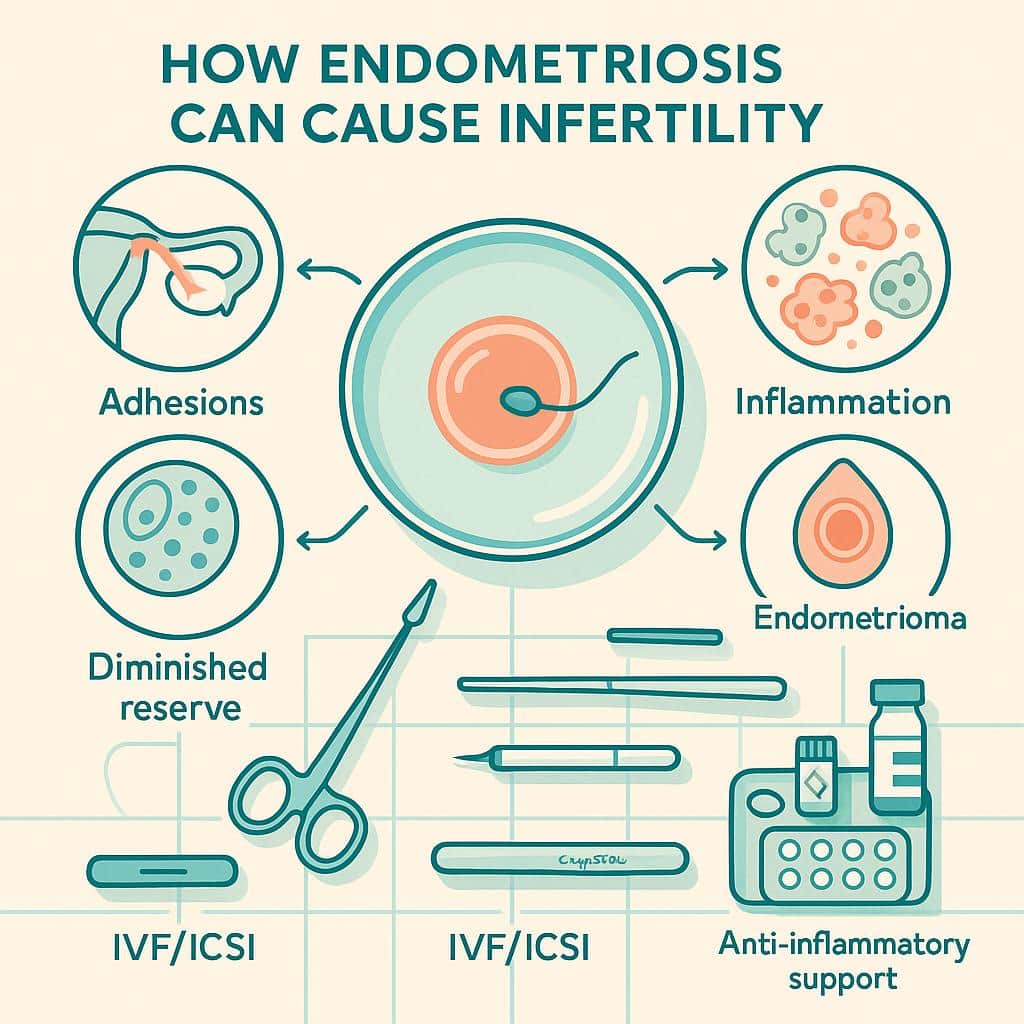
Yes, endometriomas can affect fertility and may be associated with lower ovarian reserve in some patients. Surgery, especially repeat cyst surgery, can also affect ovarian reserve because healthy ovarian tissue can be removed or its blood supply altered.
How does endometriosis affect fertility, and when to seek help?
Endometriosis can affect fertility through inflammation and scarring, but many people do conceive. In general, evaluation is recommended after 12 months of trying without success, or 6 months if you’re 35 or older; earlier evaluation is reasonable with severe pain or other risk factors.
Further reading
Making a Fertility Plan: Working with Your Endometriosis Care Team
Learn how to create a patient-centered fertility plan with your endometriosis care team, addressing symptoms, treatment, and desired timelines.
How Endometriosis Contributes to Infertility
How endometriosis leads to infertility: pathogenesis; effects on gametes, tubes, and endometrium; and treatments (expectant care, surgery, and ART).
Surgery and IVF: When Are They Right for Endometriosis?
Explore when surgery or IVF is best for endometriosis. Understand the decision-making process and what to consider for fertility and health.