


Adenomyosis
Adenomyosis is tissue like the lining of the uterus growing into the uterus's own muscle wall. It swells and bleeds there with each cycle, which can bring heavy, long periods, deep cramping and pelvic pressure. It's common, often overlooked for years, and it can sit alongside endometriosis.
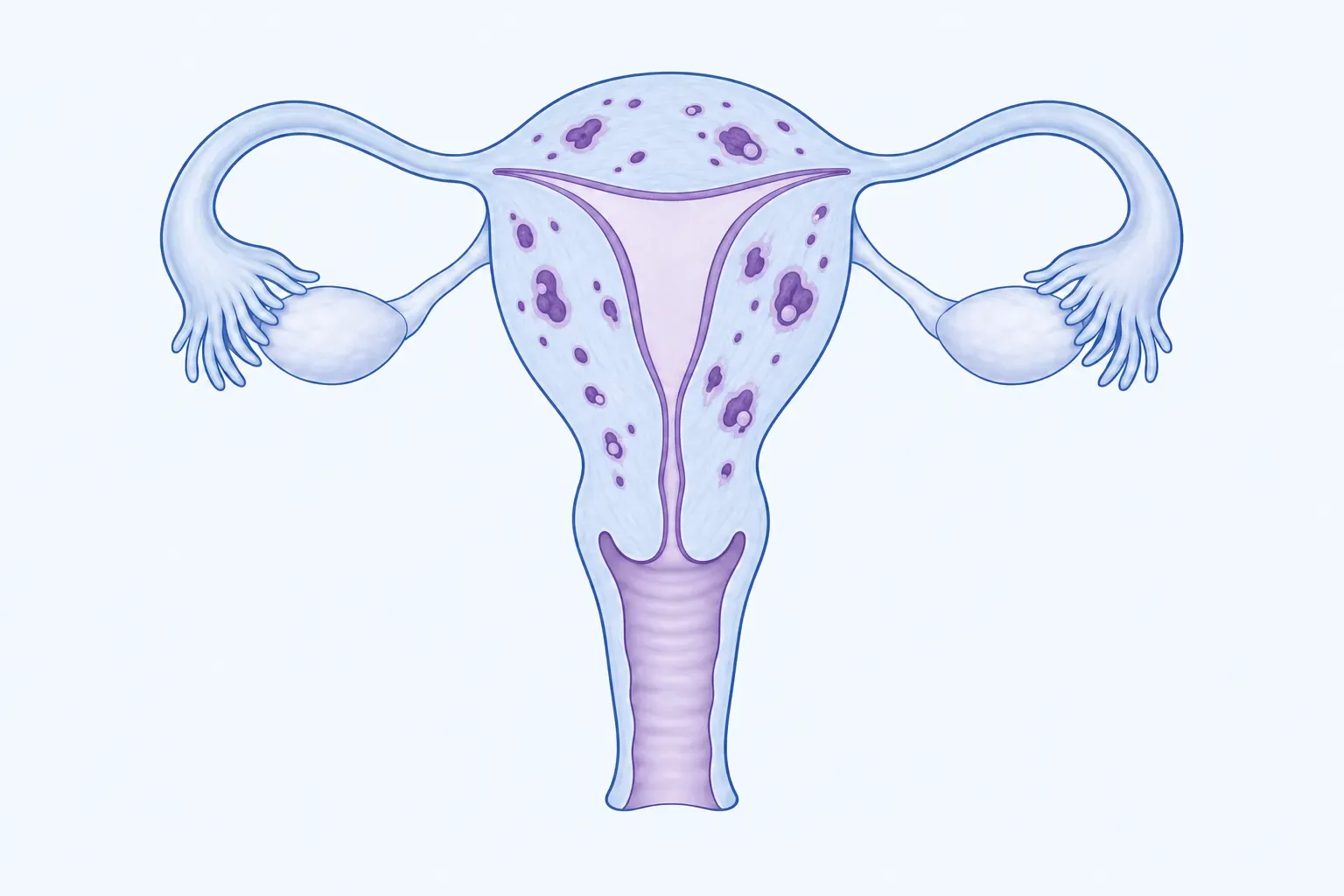
- LiningThe endometrium, shed each period
- Muscle wallThe myometrium
- AdenomyosisLining-like tissue and tiny cysts in the muscle
- 20–35%
- of women of reproductive age have it, and likely more
- Ultrasound or MRI
- finds it, read by someone who knows the signs
- One cure
- hysterectomy; hormonal care controls it
Its forms
Is it one disease?
Not quite. It can spread through the muscle wall or gather in one place, and many people have both. The pattern shapes the options more than any stage.
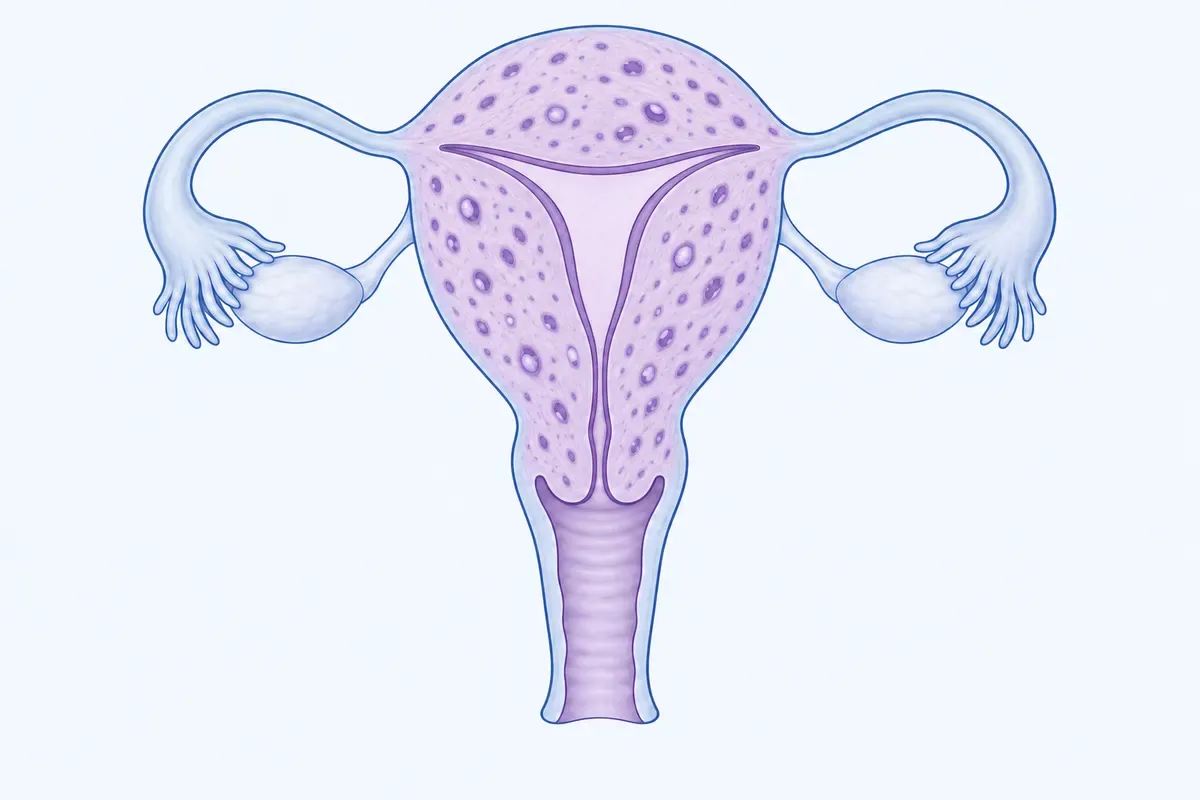
Diffuse adenomyosis
Spread through much of the muscle wall, which can leave the uterus enlarged and rounded. There's no single mass to remove, so care usually aims at long-term control of bleeding and pain.
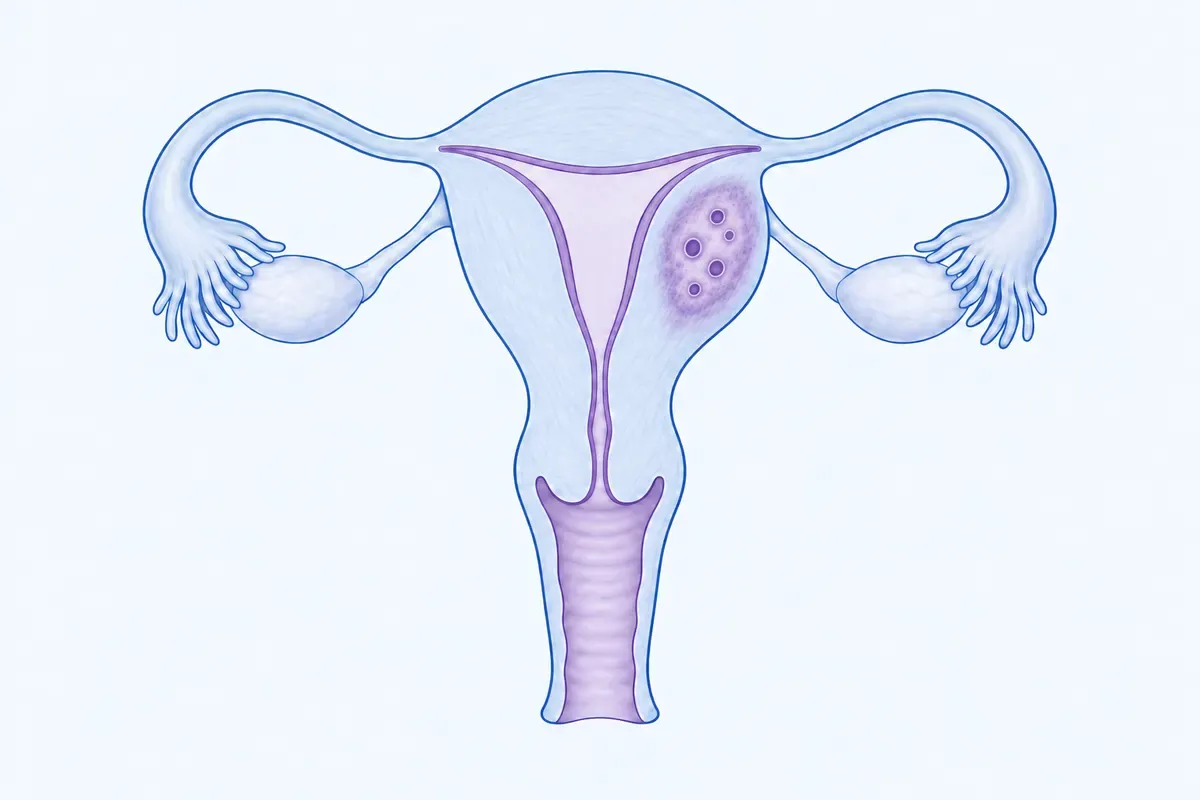
Focal adenomyosis & adenomyoma
Gathered in one area of the wall. A mass-like area is called an adenomyoma, and on a scan it can look a lot like a fibroid. Focal doesn't mean mild: a small area can still cause severe bleeding or pain.
- There's no staging system
Words like "mild" or "severe" on a report describe what the scan shows, not how much it hurts. Ask instead whether it looks diffuse, focal or mixed, how deep it goes, and whether fibroids or endometriosis are there too.
- It isn't endometriosis, but often comes with it
Adenomyosis stays inside the uterus; endometriosis grows outside it. They often occur together, and when both are present, treating only one can leave symptoms behind.

Symptoms
Does this sound familiar?
Mostly in the period: heavy or long bleeding and deep, aching cramps. Symptoms don't always match what a scan shows.
Many people describe a uterus that feels heavy, sore and tender, with pressure in the pelvis, or bloating and a low back ache that follow the cycle. Some live with it for years after being told heavy, painful periods are normal.
- Heavy bleedingLong, heavy periods, sometimes with clots or flooding
- Painful periodsDeep, aching cramps that can outlast the bleeding
- Pelvic painPressure, heaviness or a tender uterus
- BloatingSwelling that rises and falls with the cycle
- Pain during intercourseA deep ache during or after sex
- Lower back painA low ache that tracks with the period
- FatigueTiredness, sometimes from iron lost to heavy bleeding
- InfertilityIt can make implantation harder and is linked to miscarriage
How much it hurts doesn't track how it looks. Some people have severe pain or bleeding with subtle changes on imaging; others have extensive changes and milder symptoms. A scan that "looks mild" is no reason to dismiss pain that isn't.

Diagnosis
How is it diagnosed?
Usually with an expert ultrasound, and MRI when more detail would change the plan. Only a pathologist, after a hysterectomy, can confirm it for certain.
- Your history and an examYour periods, your pain, any fertility plans and what's been tried.
- An expert transvaginal ultrasoundThe starting pointA scan by someone trained to look for adenomyosis, using a standard set of signs (MUSA), finds it far more often than a routine pelvic scan.
- MRI, when more detail would change the planWhen fibroids get in the way, or when surgery or fertility treatment is being planned.
- Confirmation by a pathologistOnly after a hysterectomy, and no longer needed to start treatment.
What a report might say
What does “heterogeneous myometrium” mean on imaging?
A heterogeneous myometrium means the uterine muscle looks uneven in texture on ultrasound or MRI rather than smooth and uniform. It is an imaging description, not a diagnosis by itself. Adenomyosis is one common reason, but imaging cannot always confirm it with certainty.
What does junctional zone thickening on MRI mean?
Junctional zone thickening on MRI means the inner muscle layer of the uterus looks thicker than expected. It is commonly associated with adenomyosis, but is not a definitive diagnosis by itself and needs to be interpreted alongside your symptoms and other MRI details.
Treatment
What are the options?
Start from the goal: less bleeding, less pain, a pregnancy, or a cure. Hormonal care controls adenomyosis; hysterectomy is the only cure.
Hormonal care
A 52 mg levonorgestrel IUD is the mainstay: it can cut bleeding and pain while keeping the uterus. Continuous pills or progestins are alternatives, and GnRH medicines are used short-term. A fair trial takes a few months.
- Keeps the uterus
- Yes
- Cures it
- No, controls it
Keeping the uterus
Uterine artery embolization and energy-based treatments help some people, though results vary and they aren't usually advised if you plan a pregnancy. In carefully chosen focal cases, the adenomyoma itself can be removed.
- Keeps the uterus
- Yes
- Cures it
- Not reliably
Hysterectomy
Removing the uterus is the only treatment that reliably removes adenomyosis. It's a valid choice, not a failure of other treatments, and planning it includes a look for endometriosis, which hysterectomy alone doesn't treat.
- Keeps the uterus
- No
- Cures it
- Yes
Every operation we offer, for endometriosis too: Surgery & Advanced Excision
Who treats it
Dr. Steven Vasilev, MD
Board-Certified Gynecologic Oncologist & Integrative Medicine Diplomate, Advanced Robotic Endometriosis Excision Surgeon, Director of Lotus Endometriosis Institute
Adenomyosis often sits alongside endometriosis, and treating only one can leave symptoms behind. He looks for both, and plans care around your goal: less bleeding, less pain, a pregnancy, or a cure.
Patients often ask
Can you have both endometriosis and adenomyosis?
Yes, many patients can have both endometriosis and adenomyosis at the same time. Their symptoms may blend together, and having both can affect treatment planning because endometriosis is outside the uterus while adenomyosis is within the uterine muscle.
Can adenomyosis be cured?
Adenomyosis can be definitively cured by removing the uterus (hysterectomy), because it lives within the uterine muscle. Many other treatments can significantly reduce pain and bleeding, but they control symptoms rather than provide a permanent cure.
Can adenomyosis affect fertility or pregnancy?
Yes, adenomyosis can affect fertility and pregnancy, although not everyone will struggle to conceive. It may interfere with implantation and is associated with higher risks of miscarriage and preterm birth, especially with more diffuse disease.
What treatments can help avoid hysterectomy for adenomyosis?
Anti-inflammatory medications and hormonal treatments, including a progestin IUD, can help reduce adenomyosis symptoms without hysterectomy. Selected uterus-sparing procedures may also help, but results vary and symptoms can return.