


Diffuse adenomyosis
Adenomyosis spread through much of the uterus's muscle wall, rather than gathered in one place. With no single mass to remove, care aims at long-term control of bleeding and pain.
Medically reviewed by Dr. Steven Vasilev, MD
Board-Certified Gynecologic Oncologist & Integrative Medicine Diplomate, Advanced Robotic Endometriosis Excision Surgeon, Director of Lotus Endometriosis Institute · Updated Nov 2026
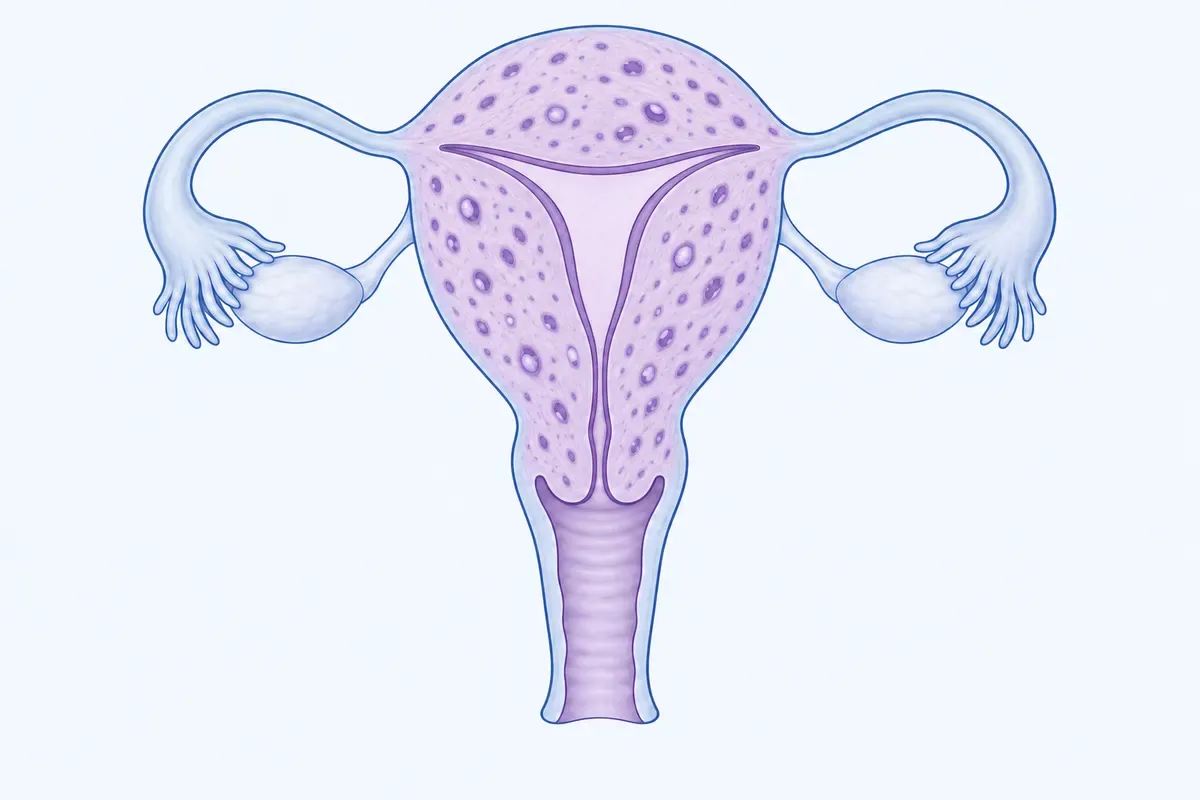
- AdenomyosisLining-like tissue and tiny cysts spread through the whole wall
- The liningThe endometrium, shed each period
- The uterusOften enlarged, rounded and tender
- No single mass
- so it usually can't be cut out
- Hormonal IUD
- the 52 mg levonorgestrel IUD is the mainstay of care
- Hysterectomy
- the only cure, and a valid choice, not a failure
The basics
What is it?
Adenomyosis spread through much of the muscle wall rather than gathered in one place. The uterus can become enlarged, rounded and tender, and because the changes run through the wall, there's no single area to cut out.
Three things to know
- It often comes with other findings
Diffuse adenomyosis can sit alongside an adenomyoma, fibroids or endometriosis. Each can add to the bleeding or pain, so a plan has to account for more than the diffuse pattern alone.
- There's no staging system
Words like "mild" or "severe" on a report describe the scan, not how it feels. More useful: whether it looks diffuse, focal or mixed, how confident the reading is, and whether the junctional zone is thickened.
- Your goal shapes the plan
The best treatment for heavy bleeding isn't always the best for pain or for a pregnancy. Agreeing on the main goal first, and how you'll judge progress, makes each next step clearer.

Symptoms
How does it show up?
Mostly in the period: heavy, long bleeding and deep cramps, often with a heavy, tender uterus. With diffuse disease, bleeding can be persistent and pain more constant.
Some people live with it for years after being told heavy, painful periods are normal. A report that sounds vague or "mild" is no reason to dismiss symptoms that aren't. When it gathers in one place instead, see focal adenomyosis.
- Heavy bleedingLong, heavy periods, often with clots or flooding
- Painful periodsDeep, aching cramps that can last beyond the bleeding
- Pelvic painPressure and a heavy, tender uterus
- BloatingA swollen, full belly as the uterus enlarges
- Pain during intercourseA deep ache during or after sex
- Lower back painA low ache that follows the cycle
- FatigueTiredness, often from iron lost to heavy bleeding
- InfertilityIt can make implantation harder and is linked to miscarriage
Heavy bleeding with fainting or significant dizziness, or severe pain that's quickly getting worse, needs urgent care.

Diagnosis
How is it diagnosed?
Usually with an expert transvaginal ultrasound, and MRI when more detail would change the plan. Most people don't need surgery just to confirm it.
- Your history and an examAt the first visitYour bleeding, your pain, what's been tried, and any plans for pregnancy, which shape every decision after.
- Expert transvaginal ultrasoundThe starting pointLooks for a standard set of signs (MUSA): tiny cysts and bright lines or buds in the muscle, a rounded uterus, an uneven wall, and an irregular junctional zone.
- MRIIf it changes the planHelps when the ultrasound is unclear, symptoms are severe, or fertility treatment or a procedure is being planned. It's very specific for adenomyosis and shows how far it reaches.
- Looking for what else is thereAlongsideFibroids, an adenomyoma, endometriosis or an endometrioma, and anemia from heavy bleeding: each changes the plan.
A report with only indirect signs sits in a gray zone, so it's read alongside the specific findings and your symptoms. A vague report reflects the limits of imaging, not the reality of your symptoms.
What a report might say
How is diffuse adenomyosis confirmed on MRI or ultrasound?
Diffuse adenomyosis is usually suggested, not proven, by MRI or ultrasound findings that match your symptoms. MRI may show a thickened junctional zone and tiny cysts in the uterine muscle; ultrasound may show streaky muscle, asymmetric thickening and fan-shaped shadowing.
What does “heterogeneous myometrium” mean on imaging?
A heterogeneous myometrium means the uterine muscle looks uneven in texture on ultrasound or MRI rather than smooth and uniform. It is an imaging description, not a diagnosis by itself. Adenomyosis is one common reason, but imaging cannot always confirm it with certainty.
What does junctional zone thickening on MRI mean?
Junctional zone thickening on MRI means the inner muscle layer of the uterus looks thicker than expected. It is commonly associated with adenomyosis, but is not a definitive diagnosis by itself and needs to be interpreted alongside your symptoms and other MRI details.
Treatment
What are the options?
Start from the goal: less bleeding, less pain, a pregnancy, or a cure. Hormonal care is the backbone of treatment; hysterectomy is the only cure.

Hormonal care
A 52 mg levonorgestrel IUD is the mainstay: it can cut bleeding and pain while keeping the uterus. Irregular bleeding is common at first, so a fair trial takes several months. Continuous pills or progestins are alternatives; GnRH medicines are short-term.
- Keeps the uterus
- Yes
- Cures it
- No, controls it

Embolization or energy treatment
Uterine artery embolization and energy-based treatments keep the uterus and help some people, though results vary and symptoms can return. They aren't usually advised if you plan a pregnancy.
- Keeps the uterus
- Yes
- Cures it
- Not reliably

Hysterectomy
Removing the uterus is the only cure, and with diffuse disease and life-altering symptoms it can bring real relief. It's a valid choice, not a failure of other treatments, and planning it includes a look for endometriosis.
- Keeps the uterus
- No
- Cures it
- Yes

If you want to get pregnant
Diffuse adenomyosis can make implantation harder and is linked to miscarriage, though studies vary. With IVF, calming it with medication before an embryo transfer may be part of the plan, decided with a fertility specialist.
When it gathers in one place instead: focal adenomyosis and adenomyoma
Who treats it
Dr. Steven Vasilev, MD
Board-Certified Gynecologic Oncologist & Integrative Medicine Diplomate, Advanced Robotic Endometriosis Excision Surgeon, Director of Lotus Endometriosis Institute
Diffuse adenomyosis often sits alongside fibroids or endometriosis, and treating only one can leave symptoms behind. Dr. Vasilev looks for all of them, and plans care step by step around your goal: less bleeding, less pain, a pregnancy, or a cure.
Patients often ask
Diffuse vs focal adenomyosis: what’s the difference?
Diffuse adenomyosis is spread throughout much of the uterine muscle, while focal adenomyosis is confined to one area and may form a mass called an adenomyoma. A focal lesion may be better suited to uterus-sparing surgery, while diffuse disease can be harder to remove without weakening the uterus.
Can diffuse adenomyosis be managed without hysterectomy?
Yes, diffuse adenomyosis can often be managed without hysterectomy, especially for symptom control and preserving the uterus. Many patients feel meaningful improvement with hormone-based therapies; uterus-sparing procedures may be considered in carefully selected cases.
Does diffuse adenomyosis affect fertility and miscarriage risk?
Diffuse adenomyosis can affect fertility by changing uterine contractions and the environment where an embryo implants. For some patients, this can contribute to difficulty conceiving and may be associated with a higher risk of early miscarriage.
Will a hormonal IUD help adenomyosis, and affect future fertility?
A hormonal IUD can reduce heavy bleeding and period pain from adenomyosis without permanently reducing fertility. Ovulation and the ability to conceive typically return soon after removal, though symptom relief can be less complete with severe or diffuse adenomyosis.