


Evaluating Cancer Risk in Endometriosis
What the evidence says about links to ovarian, breast, thyroid, and cervical cancers—and practical steps to understand and reduce your risk
Understanding the Connection Between Endometriosis and Cancer Risk
Endometriosis is not cancerous, but it can exhibit cancer-like behavior by invading tissues and organs or spreading through the lymphatic and blood systems. Research suggests potential molecular links between endometriosis and specific cancers, grounded in genetics and epigenetics (the study of how environmental factors influence gene activity). Overall, the risk of developing certain cancers appears to be slightly increased in women with endometriosis. Additional studies indicate that adenomyosis, a closely related condition, may also be associated with a heightened risk. The reasons remain unclear, though molecular connections are being uncovered, and the degree of risk varies by cancer type.
Endometriosis and Cancer Risk Transformation
Cells from endometriosis can directly transform or degenerate into cancer. The types identified are clear cell, endometrioid, and, more rarely, stromal sarcoma. The exact percentage is unknown due to under-reporting of both endometriosis and these transformation events, but estimates suggest it is only a fraction of 1%. While this fraction is small, the large number of people affected by endometriosis means that tens of thousands may still be at risk.
Endometriosis and Ovarian Cancer Risk
Endometriosis has been linked to an increased risk of developing certain types of ovarian cancer. Studies show that those with endometriosis are more likely to develop clear cell and endometrioid ovarian cancers than those without the condition, with the risk estimated at 1.5 to 3 times higher. The risk is highest when the ovaries are significantly involved, such as with endometriomas.
The mechanisms behind this association are not fully understood, but chronic inflammation and scarring associated with endometriosis may promote cancerous mutations or epigenetic events in cells. Although the risk is increased, most people with endometriosis will not develop ovarian cancer. Still, as with direct malignant transformation, even a small percentage translates to thousands to tens of thousands of affected individuals when considering the overall number of people with endometriosis.
Endometriosis and Thyroid Cancer
Multiple studies consistently report a smaller but statistically significant 1.4-fold higher risk of thyroid cancer in people with endometriosis. The cause is unknown, though some researchers propose a shared autoimmune foundation connecting endometriosis, thyroid disease, and cancer.
Endometriosis and Breast Cancer
Evidence suggests a very small association between endometriosis and breast cancer, with an approximately 4% increased risk. Some studies indicate a somewhat higher risk. However, this association is not as well established as the relationship with ovarian cancer, and further research is needed for confirmation.
Worried About Cancer Risk?
Our specialists are here to help you understand your condition and explore your treatment options.
Schedule Your CheckupEndometriosis and Cervical Cancer
Unlike ovarian and breast cancer, there is no clear link between endometriosis and cervical cancer. A handful of studies even suggest a reduced risk in people with endometriosis, though the reason for this is unknown.
Endometriosis and Other Cancer Risks
While an association with uterine endometrial cancer might be expected, evidence is mixed. A recent meta-analysis reported no increased risk, whereas other studies have found a significantly increased risk in those with endometriosis and adenomyosis. Findings are also conflicting for colorectal cancer; skin cancers, including melanoma; leukemia; lymphoma; urinary cancers; and gastric or liver cancer. Notably, several studies reported no increased colon cancer risk, but one study suggested the risk might be as high as thirteen-fold.
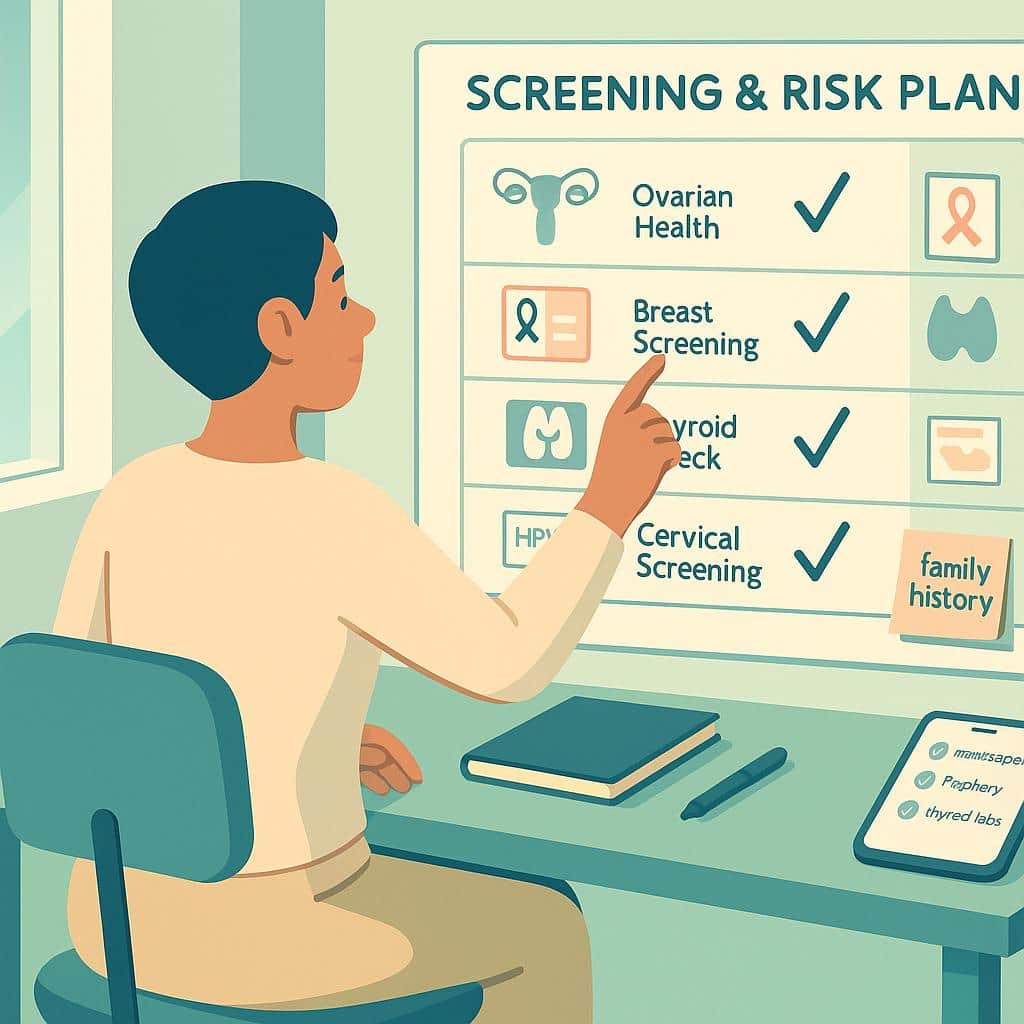
At-a-Glance Summary of Reported Cancer Risks
Cancer type | Reported relationship with endometriosis | Magnitude/detail |
|---|---|---|
Ovarian (clear cell, endometrioid) | Increased risk | 1.5–3 times higher; highest with ovarian involvement such as endometriomas |
Thyroid | Increased risk | 1.4-fold higher |
Breast | Slightly increased risk | About 4% higher; some studies suggest somewhat higher |
Cervical | No clear link; possibly reduced risk | Reduced risk suggested in a handful of studies | |
Uterine endometrial | Mixed evidence | Meta-analysis suggests no risk; other studies report significantly increased risk (especially with adenomyosis) |
Colorectal | Conflicting findings | Many studies show no increase; one study reports up to thirteen-fold risk |
Skin (including melanoma), leukemia, lymphoma | Conflicting findings | No consensus on increased risk |
Urinary, gastric, liver | Conflicting findings | No consensus on increased risk |
Managing Your Endometriosis and Cancer Risk
If you have endometriosis, staying informed about potential cancer risks and taking proactive steps can be helpful. Consider regular cancer screening appropriate for your age and personal risk factors, maintain a healthy lifestyle, and discuss any concerns with your doctor. A genetically founded increased risk may be present in some individuals, so if cancer and/or endometriosis runs in your family, consulting an expert may be best. If you are older and have endometriosis, it may also be advisable to seek expert consultation. Awareness and proactive care are valuable, and it is equally important to remember that although risk may be increased, most people with endometriosis will not develop cancer.
References
Kvaskoff M, Mahamat-Saleh Y, Farland LV, Shigesi N, Terry KL, Harris HR, Roman H, Becker CM, As-Sanie S, Zondervan KT, Horne AW, Missmer SA. Endometriosis and cancer: a systematic review and meta-analysis. Hum Reprod Update. 2021 Feb 19;27(2):393-420. doi: 10.1093/humupd/dmaa045. PMID: 33202017.
Quick Answers
Why does ovarian cyst pain keep coming back?
Ovarian cyst pain can feel “recurrent” for a few different reasons. Some cysts are functional (they form with ovulation and then resolve), so the pain returns in a similar spot month after month even though it’s not the exact same cyst. In other cases, the cyst itself can come back or persist—especially if it’s an endometrioma (an ovarian cyst caused by endometriosis), which can behave differently than a simple cyst and may be associated with deeper pelvic disease.
Another common reason is that the cyst isn’t the whole story: endometriosis on the pelvic sidewall, uterosacral ligaments, bowel, bladder, or around the ovary can irritate the same nerves and tissues and make it feel like “my cyst is back” when the driver is actually inflammatory disease nearby. Adhesions (scar-like bands) can also tether the ovary and cause recurring pulling or sharp pain, even when imaging doesn’t show a large cyst. If your pain cycles, escalates, returns quickly after a “normal” ultrasound, or keeps recurring despite prior treatment, our team can help you map the pattern, interpret imaging with an endometriosis lens, and decide whether targeted evaluation and—when appropriate—excision surgery is the next best step.
Why do I have chronic fatigue and pelvic pain?
Chronic fatigue plus pelvic pain often feels “unexplainable” because it’s rarely caused by just one issue—and many of the most common drivers don’t show up on routine labs or a quick ultrasound. Endometriosis and adenomyosis can cause persistent pelvic pain, painful periods, bowel/bladder symptoms, and deep fatigue through inflammation, disrupted sleep, heavy bleeding (and possible iron deficiency), and the sheer energy cost of living with ongoing pain. It’s also common for more than one gynecologic condition to coexist—like fibroids, polyps, or benign cysts—so a single label may not fully match what you’re experiencing.
Another reason symptoms can persist is that the nervous system can become more pain-sensitive over time (often called central sensitization), meaning pain can spread, linger outside your cycle, or feel disproportionate to what imaging shows. In those cases, symptom relief alone can miss the bigger picture: we think in terms of both treating disease (for example, addressing endometriosis lesions or uterine drivers like adenomyosis/fibroids) and building a personalized pain-management plan so your body can “turn down the volume” on pain signals.
If your fatigue and pelvic pain have been brushed off or left without a clear plan, our team can help you sort through the likely contributors, including endometriosis/adenomyosis and common coexisting conditions, and map next steps that fit your goals. You can explore our educational resources on fatigue, chronic pelvic pain, and comprehensive treatment approaches, and reach out to schedule a consultation when you’re ready.
Why is my period pain so severe it disrupts my daily life?
Severe, life-disrupting period pain isn’t “normal cramps,” and it often points to an underlying driver that deserves a real explanation—not just symptom masking. One common cause is endometriosis, where tissue similar to the uterine lining grows outside the uterus and can irritate pelvic structures, trigger inflammatory chemicals, and sometimes involve organs like the bowel or bladder. Another key point is that pain severity doesn’t reliably match “stage,” so someone can have intense pain even if imaging looks normal or disease appears limited.
When period pain is severe, worsening over time, starts years after your first period, or comes with heavy bleeding, painful sex, bowel pain with periods, urinary pain, or fatigue, we think in patterns—because endometriosis and related conditions can overlap with pelvic floor dysfunction, nerve pain/central sensitization, GI dysbiosis, vascular issues, or adenomyosis. Our approach is to take your full timeline and flare pattern seriously and then tailor evaluation with careful exam and expertly interpreted imaging when helpful. If your pain is disrupting school, work, relationships, or daily functioning, reach out to schedule a consultation—our team can help you identify what’s driving it and map out a plan aimed at lasting relief.
How rare is endosalpingiosis?
Endosalpingiosis is generally considered uncommon, but “how rare” it is depends heavily on who’s being studied and how it’s found. Many cases are discovered incidentally on pathology—meaning tissue is identified under the microscope after surgery done for other reasons—so it’s likely underrecognized in the general population. In other settings (like surgical cohorts), it may appear more often simply because more tissue is being sampled and examined carefully.
What matters most for patients is that endosalpingiosis can be confused with endometriosis on imaging or even at surgery, yet it doesn’t always behave the same way clinically. If you’ve been told you have endosalpingiosis and you also have pelvic pain, bowel/bladder symptoms, or fertility concerns, our team can help interpret what that finding means in the context of your symptoms and operative/pathology reports. You’re welcome to explore our educational content on related endometriosis and uterine conditions, and reach out to schedule a consultation if you want a personalized plan.
How does estrogen affect the endometrium?
Estrogen is one of the main hormones that drives endometrial growth. In the first half of the menstrual cycle, rising estrogen signals the endometrium to thicken and rebuild after a period, preparing the uterus for a possible pregnancy. It also influences the local immune and inflammatory environment in the uterus, which is part of why hormonal shifts can change bleeding patterns and pain.
When estrogen’s growth signals are strong—and progesterone’s “calming” effect is weaker than expected (often described as progesterone resistance)—the endometrium can behave in a more persistently inflamed, reactive way. This hormone–inflammation pattern is especially relevant in estrogen-dependent conditions like adenomyosis and endometriosis, where tissue similar to the endometrium can contribute to ongoing symptoms. If you’re trying to make sense of heavy bleeding, severe cramping, or cycle-linked pelvic pain, our team can help you connect the hormonal biology to what you’re feeling and review next steps for diagnosis and treatment.