



Gynecologic Oncologists - Safest Choice for Complex Endometriosis Surgery?
How oncology-level training can translate to more effective surgical outcomes for endometriosis — even when you don't have cancer.
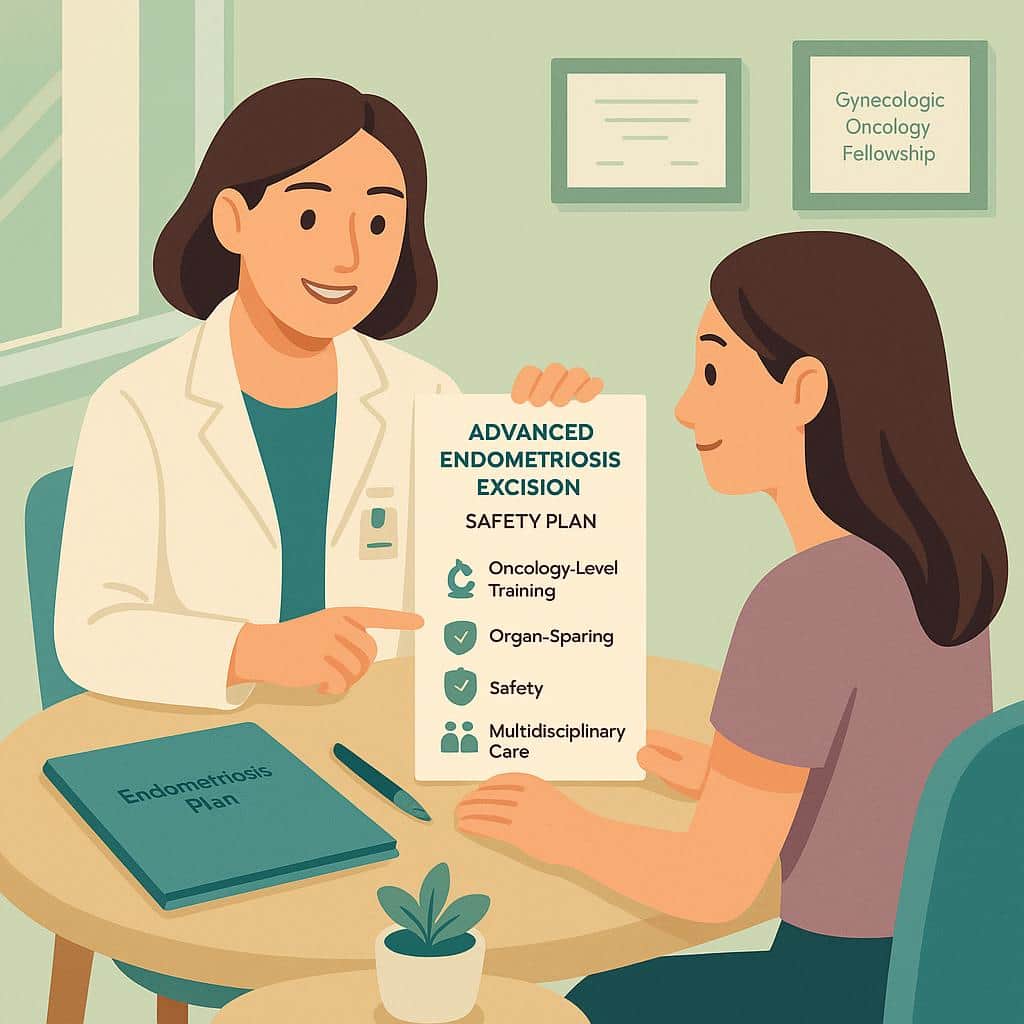
Understanding Why Surgeon Training Matters for Endometriosis Care
Endometriosis is inherently very unpredictable. Even with excellent imaging and careful evaluation, the true severity of the disease often isn’t fully known until the minute surgery begins. It can hide behind organs, wrap around the bowel or ureters, distort anatomy, turn into fibrosis reminiscent of a concrete block, mimic other conditions, or spread farther than imaging can reveal --- especially problematic if spread is into the upper abdomen. As a result, cases that appear moderate beforehand may prove far more complex during surgery, and that level of complexity requires a surgeon with advanced training.
This is where the training of your surgeon becomes critically important, because handling advanced disease safely depends on a depth of surgical experience that not all specialists possess. Yes, a team of various speciality surgeons can salvage situations, IF they are available. When advanced disease is not suspected, the risk is that availability might be limited.
Why Would a “Cancer Surgeon” Operate on Endometriosis?
Many patients understandably wonder why a surgeon trained in cancer care would be involved in treating endometriosis. Even though “gynecologic oncology” sounds like a cancer-only specialty, these surgeons are actually fellowship trained at the highest ACGME accredited level of pelvic surgery that exists within all of gynecology.
Their training covers:
- advanced retroperitoneal anatomy
- multi‑organ dissection and reconstruction from pelvis to diaphragm
- complex adhesions and frozen pelvis cases
- safe mobilization of the bowel and ureters
- management of emergencies or difficult revision surgeries
This makes gynecologic oncologists uniquely capable of handling cases where the disease turns out to be more widespread than expected. So although the name focuses on cancer, the skill set is extremely relevant — and often essential — for difficult endometriosis cases. You do not need to have cancer to benefit from that level of expertise.
It is no secret that medical groups, hospitals, individual gynecologists and even MIGS surgeons highly depend upon gynecologic oncologists to be available for management of difficult situations like hemorrhage, extremely distorted anatomy due to infection or disease, complications management and so on. Advanced endometriosis is part of this spectrum of needs.
Why This Matters for You: “Better to Have It, and Not Need It”
Many endometriosis surgeries look straightforward at first, but once you’re on the operating table, things can change quickly. If your surgeon encounters extensive disease — such as deep infiltrating endometriosis, organ involvement (bowel, bladder, ureters), dense scarring from prior procedures, or even a frozen pelvis — they must be able to address it immediately and safely. When they cannot, patients may face incomplete surgery, the need for a second operation, higher complication rates, or disruptions to anatomy that can affect long‑term outcomes through complications.
A surgeon with the highest level of pelvic surgical training can adapt safely and effectively, even if your disease turns out to be far more extensive than expected. That’s why choosing a surgeon with maximal training is not about assuming your case will be severe — it’s about being fully prepared if it is.
“I Don’t Have Cancer… Shouldn’t I See a General GYN or MIGS Surgeon?”
It is a natural question, and one that highlights how confusing and misleading specialty names in medicine can be, but the fact is that endometriosis behaves more like a complex infiltrative disease (very much like cancer) than a simple benign condition. It often affects multiple structures — including reproductive organs, the bladder, bowel, ligaments, nerves, and deeper compartments like the retroperitoneum where the ureters, nerves and large blood vessels live— which is why it requires a surgeon who can navigate all of these areas confidently.
This is why gynecologic oncology surgeons hands down are the best trained to surgically treat extensive multi-organ or multi-site pelvic disease — including endometriosis. Some general gynecologists or minimally invasive surgeons (MIGS trained) may be excellent for routine, straightforward or even moderately complex cases. But when there’s risk of deeper disease, organ involvement, or significant fibrotic scarring, the expertise of a highly trained pelvic surgeon becomes crucial.
To round out full disclosure, the vast majority of gynecologic oncologists do not study endometriosis and are not experts in the A to Z management of endo. Nor are all gynecologic oncologists experts in minimally invasive surgery for advanced cases of cancer or benign disease like endo, whether it be laparoscopic or robotic. In the right situation most can still can play a very important role for difficult surgical situations.
Get Expert Care for Complex Endometriosis
Our specialists are here to help you understand your condition and explore your treatment options.
Schedule Your ConsultWhy Lotus Endo Is Different
At Lotus Endometriosis Institute, we offer something beyond this and truly unique: Dr. Steven Vasilev, a gynecologic oncologist who devotes his surgical practice exclusively to endometriosis, adenomyosis and cancers that can be related in those with a family history, genetic anomies or are simply older. Along those lines he has a special skill set in robotic advanced ovarian cancer resection called cytoreduction which is quite like endometriosis excision surgery, except perhaps worse because life and death are on the line. He is not the only one, but only a relative handful of gynecologic oncologists internationally possess this additional minimally invasive excision expertise for advanced cases.
Dr. Vasilev's full focus has also been understanding endometriosis and adenomyosis at a deep clinical and molecular level, crafting evidence supported treatment plans and operating on the most complex patterns of endometriosis. Patients receive the full benefit of a surgeon whose expertise is surgically elite, and unusually specialized. Very few surgeons combine this level of training and experience with such a dedicated clinical and research focus, which further distinguishes the care offered at Lotus.
In short, many people travel from outside California for care here at Lotus Endometriosis Institute because of the elite expertise as well as the holistic integrative approach we incorporate to help you thrive.
The Takeaway for Patients
Choosing a surgeon for endometriosis shouldn't be about labels; it’s about capability and preparedness for every level of complexity, especially when the true extent of disease often isn’t known until surgery begins.
A surgeon with the highest level of pelvic surgical training:
- keeps you safer
- increases the chances of finishing the surgery in one operation
- protects vital organs
- preserves fertility when possible
- manages unexpected findings without hesitation
And when that surgeon uses those elite skills exclusively for endometriosis and adenomyosis — like Dr. Vasilev at Lotus — you receive a level of care that is both rare and exceptionally effective. If your goal is the best possible long-term outcome, choosing the most highly trained pelvic surgeon simply gives you the greatest margin of safety and the strongest likelihood of a comprehensive, durable result.
------------------------------------
Footnote:
The interested reader is highly encouraged to fact-check the following summary in case they are concerned that their case may be difficult due to findings on imaging, a frozen pelvis on exam, or recurrence and inevitable reactive fibrosis:
Here is an objective summary of the surgical training metric differences:
GYN/ONC (Gynecologic Oncology): This is a standardized, ACGME-accredited specialty resulting in board certification in both Obstetrics & Gynecology and Gynecologic Oncology. The curriculum nationally mandates extensive training in navigating and resecting disease from vital organs (bowel, bladder, ureters, major blood vessels, diaphragm) and managing surgical complications in highly complex anatomical scenarios. A GYN/ONC surgeon has a uniformly verified, high baseline of training for severe surgical difficulty.
MIGS (Minimally Invasive Gynecologic Surgery): This is a post-residency fellowship accredited by the AAGL, which relies more heavily on the mentorship model (an apprenticeship). Most programs are not exclusively focused on endometriosis, but it is certainly almost always part of the training to a variable degree. As of 2025 there is no national, ACGME-enforced standard curriculum or board certification specifically for "MIGS" that guarantees exposure to every type of multi-visceral (multi-organ) dissection or resection. The quality and volume of complex cases encountered vary significantly from one program to another.
In objective summary terms:
It is statistically more difficult to determine the surgical competency of a MIGS surgeon for a highly distorted anatomy endometriosis case before the procedure begins compared to a GYN/ONC surgeon, because the MIGS training metrics lack external, uniform ACGME oversight to determine the background training rigor and experience. The GYN/ONC designation and board certification objectively signals a higher, standardized baseline of training for complex anatomy management, regardless of whether the disease being removed is benign or malignant.
The caveat, as always, is that within ANY speciality there are surgeons who are far better or far worse than average. Thus there are certainly exceptions to the summary analysis, especially after experience of any given surgeon grows over the years. The secondary caveat is that there are very few gynecologic oncologists who focus on or exclusively manage endometriosis and adenomyosis. However, there are certainly many MIGS surgeons who were not trained with that focus either. The tertiary caveat is that a MIGS trained surgeon working as part of a team with general surgeons and urologists, who must also possess higher level minimally invasive skills, can get the job done. However, there is a higher risk of a weak link and availability of multiple surgeons for any given case. An integrated "team" is one thing, but a loose collection of various surgeons does not make a cohesive "team".
References
Vercellini P, Viganò P, Somigliana E, Fedele L. Endometriosis: pathogenesis and treatment. Nat Rev Endocrinol. 2014;10(5):261–275. DOI: 10.1007/s10735-025-10499-z
Zondervan KT, Becker CM, Koga K, Missmer SA, Taylor RN, Viganò P. Endometriosis. Nat Rev Dis Primers. 2018;4(1):9.
Giudice LC, Kao LC. Endometriosis. Lancet. 2004;364(9447):1789–1799. DOI: 10.1007/s00210-025-04935-w
Nezhat C, Vang N, Tanaka PP, Nezhat C. Optimal management of endometriosis and pain. Obstet Gynecol Clin North Am. 2010;37(3):403–413. DOI: 10.3389/frph.2021.792920
U.S. National Cancer Institute. Training in gynecologic oncology surgery (Fellowship standards).
Quick Answers
How is multi-organ endometriosis treated without organ removal?
In many multi-organ cases, the goal is conservative surgery: removing endometriosis while preserving the organs themselves. That typically means meticulous excision of disease from surfaces and deeper planes around the bowel, bladder, ureters, ovaries, and pelvic sidewalls—freeing organs from scar tissue and restoring normal anatomy without taking the organ out. Because endometriosis can hide in distorted or “frozen” anatomy, the safest way to preserve organs is often a highly precise approach that can dissect around vital structures.
In our practice, we use robotic excision to improve visualization and fine-control dissection, which is especially helpful when disease involves multiple compartments or has been operated on before. When endometriosis is close to structures like the ureters, bowel, diaphragm, or certain nerves, treatment planning may include coordinated work with other surgical specialists so the disease can be fully addressed in one operation while still prioritizing organ-sparing techniques.
Organ removal is usually considered only when an organ is severely damaged, there are multiple large endometriomas that can’t be safely managed with tissue-sparing techniques, fertility-safety concerns arise (like a badly damaged tube), or there’s concern for tumor or malignant change. If you’re trying to avoid organ removal, we can help map likely disease sites, clarify your priorities (pain relief, function, fertility), and outline what organ-preserving excision could realistically look like in your specific case—then build a surgical plan around that.
How much time off work do I need after endometriosis surgery?
Most people need about 2–3 weeks off work after minimally invasive endometriosis excision, especially if your job is mainly desk-based and you can ease back in. With robotic excision, patients often go home the same day or next day, start walking comfortably within about a week, and many feel ready for a gradual return to typical daily routines in that 2–3 week window.
The exact time off depends less on the incision size and more on what we need to treat during surgery—for example, ovarian endometriomas, bowel/bladder/ureter involvement, extensive scar tissue (“frozen pelvis”), or additional procedures like appendix removal or adenomyosis-related surgery. More complex, multi-organ cases can mean more fatigue, more activity restrictions, and a higher chance of needing an overnight stay, which can extend the time you’ll want to plan away from work.
In most straightforward recoveries, many patients are back to full activity by about a month. If you tell our team what you do for work (lifting, long shifts, travel, on-your-feet all day vs remote/desk), we can help you plan a realistic time-off request and a safer return-to-work ramp based on the surgical plan we’re building for you.
Why does ovarian cyst pain keep coming back?
Ovarian cyst pain can feel “recurrent” for a few different reasons. Some cysts are functional (they form with ovulation and then resolve), so the pain returns in a similar spot month after month even though it’s not the exact same cyst. In other cases, the cyst itself can come back or persist—especially if it’s an endometrioma (an ovarian cyst caused by endometriosis), which can behave differently than a simple cyst and may be associated with deeper pelvic disease.
Another common reason is that the cyst isn’t the whole story: endometriosis on the pelvic sidewall, uterosacral ligaments, bowel, bladder, or around the ovary can irritate the same nerves and tissues and make it feel like “my cyst is back” when the driver is actually inflammatory disease nearby. Adhesions (scar-like bands) can also tether the ovary and cause recurring pulling or sharp pain, even when imaging doesn’t show a large cyst. If your pain cycles, escalates, returns quickly after a “normal” ultrasound, or keeps recurring despite prior treatment, our team can help you map the pattern, interpret imaging with an endometriosis lens, and decide whether targeted evaluation and—when appropriate—excision surgery is the next best step.
What is deep infiltrating endometriosis (DIE) and how is it treated?
Deep infiltrating endometriosis (DIE) is endometriosis that grows deeper into tissue—often described as more than ~5 mm below the surface—and it commonly involves structures like the uterosacral ligaments, rectovaginal space, bowel, bladder, or ureters. Because it can inflame, scar, tether, or even narrow/obstruct nearby organs, DIE may show up as “non-gynecologic” symptoms such as bowel or urinary pain, painful sex, nerve-type pelvic pain, or symptoms that don’t match a routine pelvic exam.
Treatment depends on where the disease is and what it’s affecting, but DIE is the subtype most likely to require specialized surgical planning. When surgery is appropriate, meticulous excision (removing disease at its roots rather than burning the surface) is the gold-standard approach for durable symptom relief and for addressing organ involvement; in complex cases this can include careful work around the bowel, bladder, and ureters. Our team focuses on advanced, precision excision (often using robotic technology) with a tailored plan that prioritizes safety, completeness, and your goals—whether that’s pain relief, fertility, or protecting organ function.
Because DIE can be missed on basic exams and even “normal” imaging, evaluation often requires a higher index of suspicion and the right strategy for mapping disease before any procedure. If DIE sounds like it could explain your symptoms, explore our detailed resources on deep disease and excision, or reach out to schedule a consultation so we can review your history, imaging, and next steps together.
Why are bowel movements painful and bloating worse during my period?
Painful bowel movements and bloating that flare during your cycle are common in endometriosis—especially when disease is deep in the pelvis near the rectum/rectosigmoid, or when inflammation and scarring tether the bowel to nearby structures. Even without endometriosis growing “inside” the bowel, pelvic lesions can irritate surrounding tissue and nerves, creating cramping, pressure, and the deep, sharp pain some people feel with passing stool. Hormonal cycling can amplify inflammation and swelling, which is why symptoms often peak around bleeding and then ease. Many patients also notice alternating constipation/diarrhea or an “endo belly” pattern that tracks with their period.
These symptoms are often confusing because standard GI workups (including colonoscopy) can be normal—bowel endometriosis frequently affects the outside of the bowel wall or deeper layers rather than the inner lining that a colonoscopy evaluates. What matters most is mapping where symptoms point anatomically and whether there are red flags like cyclical rectal bleeding, escalating severity, or signs of narrowing/obstruction. Our team focuses on a whole-pelvis evaluation and, when appropriate, targeted imaging and surgical planning to confirm what’s driving your bowel pain and bloating and treat it effectively. If you’d like, you can reach out to schedule a consultation so we can review your symptom pattern and discuss next steps.