



Bowel Endometriosis and Infertility - What Should You Try First?
How to weigh IVF versus surgery when your goal is pregnancy
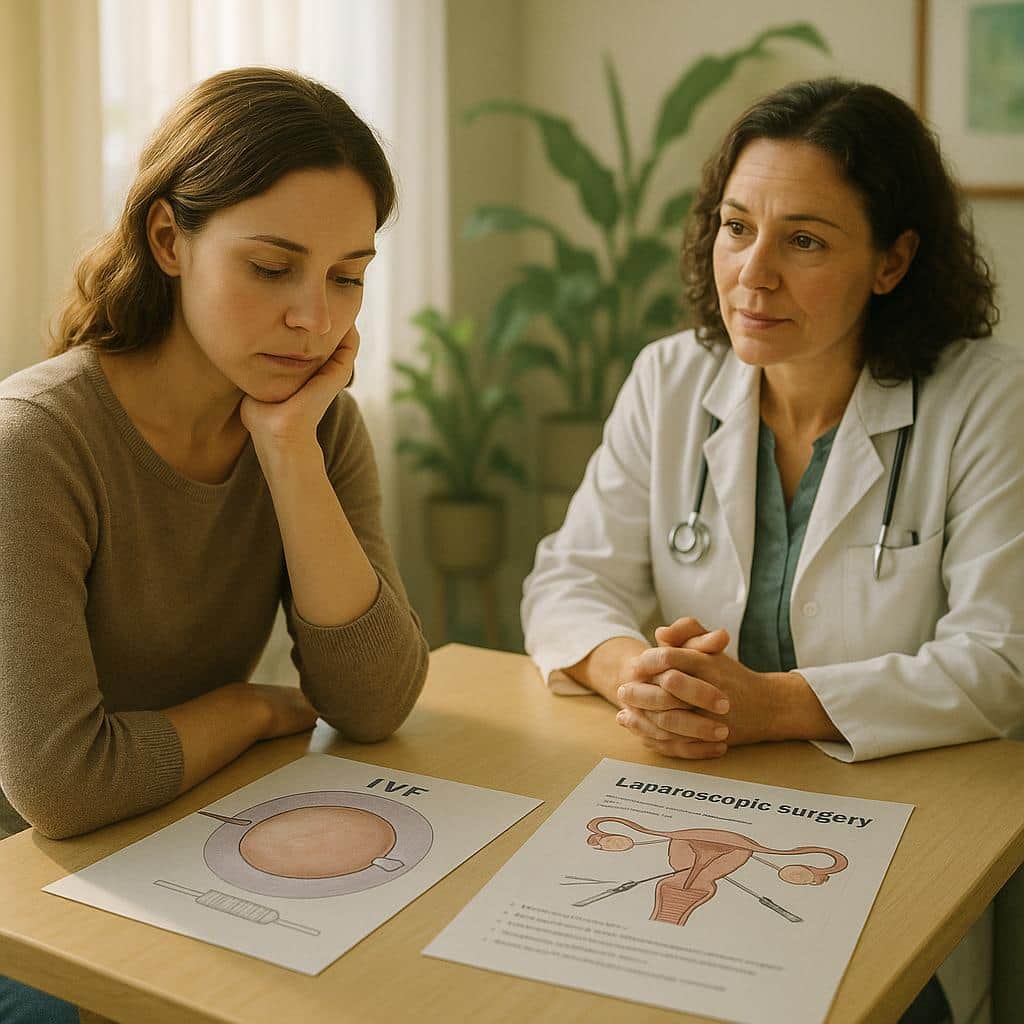
If you’ve been told you have bowel (colorectal) endometriosis and you’re trying to get pregnant, you may feel shoved into an impossible choice: “Do I do surgery first?” versus “Should I go straight to IVF?” It’s not just medical—it’s emotional. You’re trying to protect your fertility, avoid making pain worse, and not lose precious time.
Here’s the most patient-relevant truth: there isn’t one “right” first step for everyone. The best path depends on your symptoms (especially pain and bowel symptoms), your age and ovarian reserve, your prior surgeries, and whether you also have adenomyosis—which can quietly reduce pregnancy odds and change what “best next step” looks like.
Recent evidence reviews still describe a landscape where decisions are often made with imperfect data (because we lack large, high-quality randomized trials). But you can make a strong, practical plan by matching the strategy to your situation.
Your two main pathways: fertility treatment first, or surgery first
When bowel endometriosis is part of your infertility picture, most plans fall into one of these:
1) Medically assisted reproduction (MAR) or Assisted Reproductive Technology (ART) first (often IVF)
This means using fertility treatments—most commonly IVF/ICSI—without first doing bowel surgery.
This approach is often suggested when:
- Your pain is minimal or manageable
- Your main goal is pregnancy ASAP
- You’re 35+, have reduced ovarian reserve, or have already been trying a long time
- Surgery would likely be complex (and you want to avoid the risk of complications or delays) and may require bowel entry and disc excision or formal stapled resection
Why many teams favor this first when pain is minimal: bowel surgery can be life-changing for symptoms when it’s needed, but it’s also real surgery—sometimes major surgery—with risks like bowel complications, rarely temporary stomas and longer recovery time. If your day-to-day symptoms aren’t the main problem, going straight to IVF may help you pursue pregnancy while sidestepping those surgical risks.
2) Surgery first (then try naturally and/or do IVF later)
This means surgery to remove bowel endometriosis (often with excision of deep disease) before fertility treatment.
This approach is more commonly considered when:
- You have severe pain, bowel symptoms, or quality-of-life impairment
- There are red-flag bowel symptoms (more on this below)
- Disease anatomy may block normal fertility (distorted pelvis, severe adhesions, tubal involvement)
- You and your team believe surgery may give you a realistic chance of natural conception (or improve IVF conditions)
The key point you deserve to hear plainly: surgery may improve fertility for some people, but it’s not guaranteed. The data we have is mixed, and because much of it comes from observational studies (not randomized trials), it can be hard to separate “surgery helped” from “these were patients who already had better chances.”
If your pain is minimal: why IVF-first is often a reasonable default
If bowel endometriosis was found during an infertility workup and you’re not dealing with major daily pain, many experts lean toward starting with MAR/IVF.
Practical reasons this can make sense for you:
- Time matters (especially over 35). IVF can be started relatively quickly compared with complex surgical scheduling and recovery.
- Surgery has non-trivial risks. Even in excellent hands, bowel surgery can mean complications, hospital stay, and longer recovery.
- You may still need IVF after surgery anyway. Many people assume “surgery first = natural pregnancy,” but that’s not always how it plays out.
That said, “IVF-first” doesn’t mean ignoring the disease. It means your plan focuses on pregnancy first while still monitoring symptoms and bowel function—and making sure you’re not missing signs that surgery is actually needed.
When surgery-first may be the better choice for fertility and life
If bowel endometriosis is significantly affecting your life, “pregnancy at any cost” can become an unfair standard—because the cost is you living in relentless pain. Even if pregnancy can temporarily reduce symptoms of endo, due to higher progesterone levels, it may be difficult to get pregnant and take time before this relief is realized. And, it is possible that pregnancy will not occur due to the multiple challenges that extensive endometriosis presents regarding subfertility.
Surgery may be worth discussing more seriously when:
- Pain is severe, persistent, or escalating (including painful bowel movements, deep pain with sex, or cyclical bowel symptoms)
- You’ve tried medical pain management and it hasn’t helped (or you can’t tolerate it)
- Imaging suggests advanced deep infiltrating disease affecting bowel function or causing narrowing
- You want to pursue natural conception and your surgeon believes pelvic anatomy can be meaningfully restored
A crucial patient-centered nuance: surgery for symptoms is different from surgery purely to “boost fertility.” If you’re suffering, symptom relief is a valid primary goal—even if fertility benefit is uncertain. You don’t need to justify surgery only in terms of pregnancy.
Struggling with fertility? Get expert help.
Our specialists are here to help you understand your condition and explore your treatment options.
Schedule Your ConsultThe “waiting” option: expectant management (for selected patients)
Sometimes the best move is not immediate surgery or IVF—it’s a time-limited trial of trying naturally, especially if you’re younger and have a favorable prognosis.
This can be reasonable when:
- You’re younger (often under 35)
- Ovarian reserve and semen parameters look good
- Tubes appear open from testing such as HSG and pelvic anatomy isn’t severely distorted on imaging
- Symptoms are mild and stable
The important safeguard is the time limit. For many, a window such as up to 6–12 months of trying (depending on age and other factors) is discussed before moving to MAR/ART.
Adenomyosis can change the plan more than you’d expect
If you have bowel endometriosis, it’s not uncommon to also have adenomyosis. And adenomyosis can negatively affect reproductive outcomes as well—meaning it may reduce durable implantation odds, increase miscarriage risk, or make IVF less efficient for some people.
What this means for you in real life:
- If adenomyosis is present, you may want a more explicit conversation about uterine factors—not just ovaries and tubes.
- Your team may consider strategies such as pre-IVF hormonal suppression (for example, a period of GnRH analogue therapy) in selected cases, balancing benefits against side effects and delays. Keep in mind that this type of hormonal therapy, even with add-back estrogen, can lead to another sets of symptoms and potentially long standing side effects. Having stated that, in most cases it is safe for a very short purpose like this.
- If you’re being told “just do IVF” but nobody has addressed adenomyosis, it’s reasonable to ask whether your uterus has been fully evaluated (transvaginal ultrasound with an adenomyosis-aware sonographer, and MRI when needed).
Adenomyosis doesn’t mean pregnancy is impossible. It means your plan should be honest about all the variables—not focused only on the bowel endo.
How long should you try before you decide it’s not working?
A practical timeline helps you avoid the trap of “wait and see” turning into lost years.
In general:
- If you’re 35+, you’ll often want a shorter decision window before moving to MAR/ART.
- If you do surgery first, ask what the realistic time-to-try is afterward (for healing, symptom tracking, and then trying naturally), and when you would transition to IVF if pregnancy hasn’t happened.
The point isn’t rigid rules. It’s making sure you and your clinician agree on: What are we trying? For how long? What’s the next step if it fails?
Practical takeaways: questions to ask your doctor
- “Given my pain level and bowel symptoms, am I a better candidate for IVF-first or surgery-first, and why?”
- “What is my estimated chance of natural conception after surgery in my specific case?”
- “If I choose surgery, what type might I need (shaving vs disc vs segmental resection), and what are the complication rates in your hands?”
- “Could surgery affect my ovarian reserve? Will you check AMH/AFC before and after?”
- “Do I have signs of adenomyosis, and should we adjust the fertility plan because of it?”
- “What is our timeline—when do we pivot to IVF if pregnancy doesn’t happen?”
Red flags you shouldn’t ignore
Seek urgent evaluation if you have symptoms that could suggest bowel compromise or another serious issue, especially if worsening:
- New or worsening bowel obstruction symptoms (severe constipation with bloating/vomiting, inability to pass gas)
- Rectal bleeding that is heavy, persistent, or not clearly cyclical
- Severe escalating pain with fever or fainting
Reality check: why this decision feels so uncertain (and what to do about it)
You’re not imagining the ambiguity. The fertility benefits of bowel surgery are hard to quantify because we still lack large randomized trials comparing “IVF-first” versus “surgery-first” in clearly defined patient groups. Observational results can look promising, but they don’t always predict what will happen for you.
So the most empowering approach is to make your decision based on:
- Your main goal right now (pain control, pregnancy ASAP, avoiding surgery, maximizing natural conception chances)
- Your personal fertility prognosis (age, AMH/AFC, semen analysis, tubal status)
- Your symptom burden and bowel function
- Whether adenomyosis is also part of your story
If your care team can’t clearly explain why they recommend one pathway for your body and goals, that’s a reason to ask for a second opinion—ideally from a center that regularly manages deep endometriosis and infertility together, not separately. This is a very complex situation and quaternary level consultation is prudent.
References
Larraín, Caradeux, Maisto, Claure, Villegas-Echeverry, Heredia, Kondo. Infertility management in patients with bowel endometriosis: the current landscape and the promise of randomised trials. *Facts, Views & Vision in ObGyn*. 2025.. DOI: 10.52054/FVVO.2025.168
Quick Answers
How is multi-organ endometriosis treated without organ removal?
In many multi-organ cases, conservative surgery removes endometriosis and frees organs from scar tissue while preserving the organs themselves. Robotic excision can improve precision, and treatment planning may include other surgical specialists.
Why do I look pregnant from bloating with constant pelvic pressure?
Bloating that makes you look pregnant with constant pelvic pressure can come from pelvic inflammation, swelling, or a sense of bulk. Endometriosis, adenomyosis, fibroids, ovarian cysts, and bowel sensitivity can contribute, and symptoms alone don’t reliably identify the cause.
Can endometriosis cause infertility and pelvic pain in your 20s?
Yes, endometriosis can cause chronic pelvic pain and fertility challenges in your late 20s. Pain can include severe period cramps, pain with sex, and bowel or bladder pain, though symptom severity doesn’t always match how much disease is present.
What is deep infiltrating endometriosis (DIE) and how is it treated?
Deep infiltrating endometriosis (DIE) grows deeper into tissue and can affect organs like the bowel or bladder. Treatment depends on its location and effects; when surgery is appropriate, carefully removing the disease at its roots is the gold-standard approach.