



Endometriosis Biopsy: A Definitive Method for Diagnosis
How biopsies (and possible newer tools) can clarify diagnosis—especially when appearance is misleading
Why “biopsy” comes up so often in endometriosis care
If you’re being evaluated for endometriosis or adenomyosis, you may hear a frustrating mix of messages: “We can’t be sure without surgery,” “We saw spots that look like endometriosis,” or “Your exam was normal.” Patients often wonder what a biopsy actually proves, why results can disagree with what a surgeon sees, and whether there are less invasive ways to get answers.
Across multiple studies—including a large diagnostic-accuracy study of nearly 1,000 laparoscopies and several real-world reports of difficult-to-diagnose disease—the overall message is this: endometriosis is best confirmed by tissue (histology), but getting the “right” tissue is the hard part. Lesions that the surgeon may see (or miss) can be subtle, variable in appearance, and sometimes sit under a normal-looking surface or in little peritoneal pockets (Allen-Masterons pockets or windows), which is why sampling technique matters. The variables are surgeon experience, the quality of the camera being used and location of the endo implants.
This article pulls together what research suggests about when a biopsy helps most, why it can be negative even when symptoms are real, and what options exist when endometriosis hides in deeper layers (like bowel wall or peritoneum).
What does an endometriosis biopsy actually show?
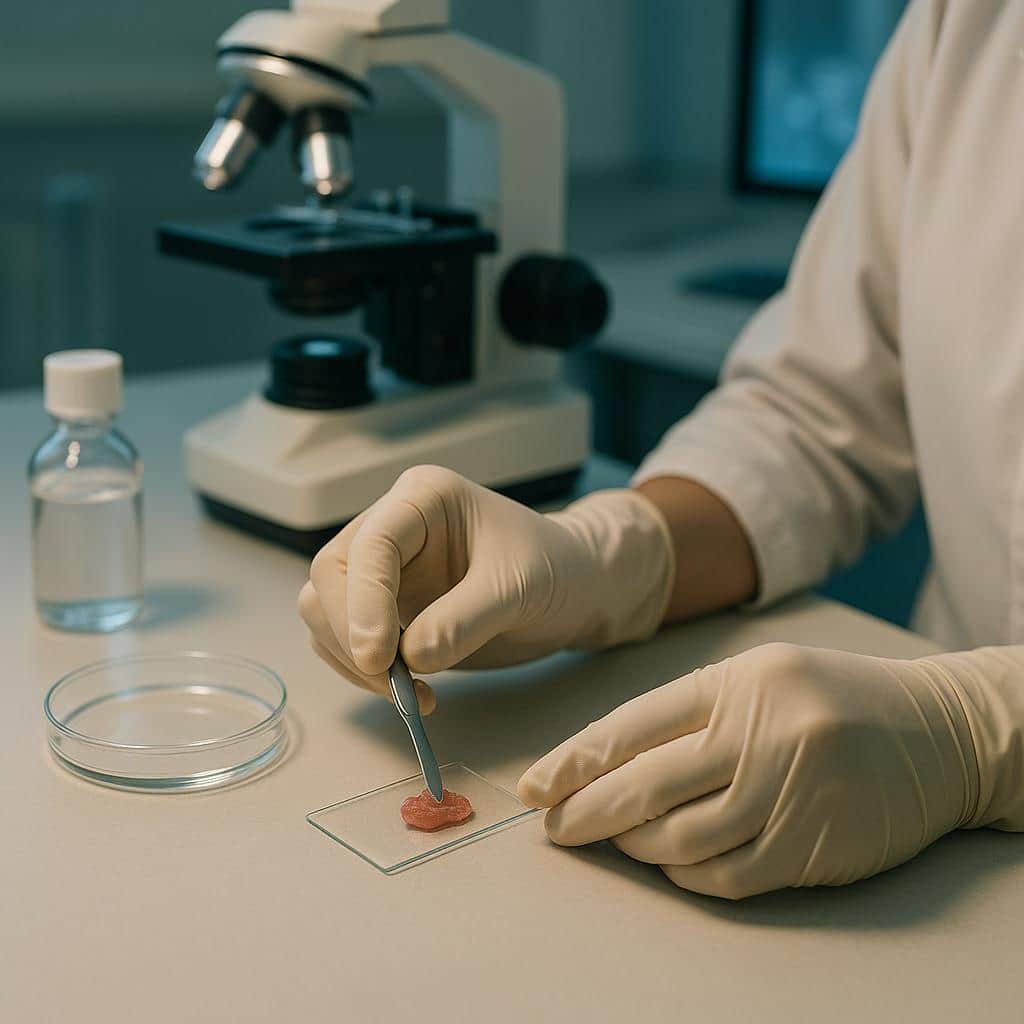
A biopsy means a small piece of tissue is sent to a pathology lab. The pathologist looks for features consistent with endometriosis—classically endometrial-type glands and stroma (and sometimes signs like hemorrhage/iron-laden macrophages). A biopsy can:
- Confirm endometriosis when tissue clearly matches
- Challenge a visual impression if tissue doesn’t support it
- Help rule out other diseases that can mimic endometriosis (including some cancers or inflammatory conditions), depending on the clinical context
Biopsy is also how many researchers obtain tissue to study endometriosis biology. For example, one 2024 study analyzed endometrial and lesion-related biopsy samples to measure oxygen consumption and metabolic gene expression, showing that different forms of disease may behave differently at the cellular level (more on why that matters later). While this kind of testing isn’t used for routine diagnosis today, it underscores an important point: endometriosis isn’t always one uniform “thing,” and that complexity can show up in how lesions look—and how easy they are to confirm.
If a surgeon “sees endometriosis,” why isn’t that enough?
Many patients assume laparoscopy or robotics is automatically definitive. In practice, they are excellent for finding and treating disease, but visual appearance alone can overcall or undercall endometriosis.
In a large study of 976 women who had laparoscopy for pelvic pain and/or infertility—where suspicious areas were compared to histopathology—laparoscopy was very sensitive (good at not missing endometriosis when it was present) had a very high negative predictive value (if laparoscopy didn’t suggest endometriosis, it was usually truly absent in that dataset). In the real world, when non-expert surgeons are involved, the negative predictive value may actually be worse that this study suggests. But even in this study, the specificity and positive predictive value were lower, meaning a meaningful portion of “looks like endometriosis” spots were not confirmed on pathology.
A smaller pilot study testing near-infrared fluorescence (NIRF) imaging during laparoscopy reinforces this theme from another angle: even among lesions that looked suspicious enough to biopsy, only about 61% actually contained endometriosis on histology. That doesn’t mean the symptoms weren’t real—it means visual suspicion does not always equal histologic confirmation.
Why might a “suspicious” lesion be negative on pathology?
A negative biopsy can happen for several reasons, including:
- Sampling error (the biopsy missed the tiny focus of endometriosis within a larger area)
- Lesion heterogeneity (some parts contain diagnostic tissue; others look inflamed or fibrotic)
- Look-alikes (scar tissue, inflammation, vascular lesions, or other benign changes that resemble endometriosis)
- Technical factors (small superficial biopsy when disease is deeper; cautery artifact)
This is why it’s reasonable to ask your surgeon: Were lesions biopsied? From where? Did pathology confirm endometriosis? Those details can affect future decisions—especially if long-term hormonal therapy, repeat surgery, or a major bowel/ureter procedure is being considered.
When biopsy becomes especially important: “rule out” situations
Most people pursue diagnosis to explain pain, bleeding, infertility, or GI symptoms. But in some situations, biopsy becomes urgent because clinicians must exclude cancer or other serious disease.
Bowel endometriosis that mimics a rectal tumor
A 2023 case report describes a woman with a rectal mass causing obstruction. Colonoscopy biopsies showed normal mucosa—yet imaging still raised concern for malignancy. The key learning: bowel endometriosis often lives in deeper layers of the bowel wall, not on the surface lining that standard biopsies sample. In that case, endoscopic ultrasound (EUS) visualized a deeper lesion and EUS-guided fine needle aspiration (FNA) provided tissue that confirmed endometriosis.
Patient-relevant takeaway: if you have severe bowel symptoms (obstruction, a “mass,” unexplained narrowing) and a colonoscopy biopsy is normal, that does not necessarily rule out bowel endometriosis. The disease may simply be out of reach of routine mucosal (inner lining of the bowel) biopsies.
Get a Clear Endometriosis Diagnosis
Our specialists are here to help you understand your condition and explore your treatment options.
Book Your Biopsy TodayRare presentations (like hemorrhagic ascites)
Another case report described recurrent massive hemorrhagic ascites (blood-stained fluid in the abdomen) with anemia and elevated CA-125—features that can also suggest malignancy. The diagnosis was ultimately made via image-guided core needle biopsy of thickened peritoneal tissue seen on ultrasound. After diagnosis, medical therapy improved symptoms and labs.
This kind of scenario is very uncommon, but it highlights an important principle: when endometriosis presents in unusual ways, clinicians may need targeted tissue sampling from an abnormal area seen on imaging—not just a “general” test.
Can biopsy be done without laparoscopy?
Sometimes. But it depends on where the suspected disease is and whether there is a safe target to sample. Also, there is a risk that the needle can miss the actual disease (even by a few millimeters) and needles introduced through the skin can cause complications.
Options that may avoid diagnostic laparoscopy in select cases
- EUS-guided needle biopsy (FNA) for deep rectal/rectosigmoid lesions reachable from inside the rectum (as in the bowel obstruction case)
- Image-guided core needle biopsy when a discrete abnormal area is visible and safely accessible (as in the hemorrhagic ascites case)
These approaches don’t replace laparoscopy for most people—especially when symptoms are pelvic and imaging is non-specific—but they can be valuable when:
- malignancy is a concern,
- the lesion is deep and mucosal biopsies are negative, or
- surgery is high-risk or deferred and a tissue diagnosis would change management.
Do newer “better visualization” tools reduce the need for biopsy?
Not yet.
Surgeons are exploring technologies to detect lesions that are easy to miss in white light. One pilot study tested near-infrared fluorescence (NIRF) imaging after IV indocyanine green (ICG). It was feasible and appeared safe in that small sample, and it sometimes revealed additional suspicious areas. However, it didn’t clearly outperform standard white-light laparoscopy in terms of how often a suspected lesion actually proved to be endometriosis on pathology, and it also introduced some false alarms.
What this means for patients: these tools are promising research directions, but they don’t replace histology, and they currently shouldn’t be assumed to prevent missed disease or reduce recurrence.
What is available today that might help find otherwise difficult to find disease is better optics. Laparoscopy is usually two-dimensional (2-D). Robotics is three dimensional (3-D) and more magnified. This means subtle changes many not be visible to the laparoscopist, even if they use so-called "contact laparoscopy" which calls for extremely close inspection, whereas they are clearly visible on the robotic camera.
Where adenomyosis fits in (and why “biopsy” can mean different things)
Adenomyosis is endometrial-like tissue within the uterine muscle (myometrium). In routine care, adenomyosis is often suggested by imaging (especially transvaginal ultrasound or MRI) and symptoms; definitive diagnosis historically came from examining the uterus after hysterectomy, though that’s not appropriate or desired for many patients.
The 2024 biopsy-based metabolism study is interesting here because it suggests adenomyosis tissue may show different energy-use patterns than ovarian or peritoneal endometriosis lesions. That doesn’t change how adenomyosis is diagnosed today, but it supports a patient-relevant point: endometriosis and adenomyosis are related but not identical, and future non-hormonal treatments might need to be tailored by lesion type and location.
The problem is that adenomyosis often involves the uterus like a spiderweb infiltrating the uterine muscle, so it is not accessible to an office biopsy that is often used to look at endometrial (inner lining of the uterus) abnormalities. Outpatient hysteroscopy may or may not allow enough of a deeper biopsy to definitively prove the presence of adenomyosis.
Practical takeaways (how to use this in your appointments)
If biopsy is part of your plan—or you’ve had conflicting results—these questions can help you get clarity:
- “Were biopsies taken of the suspected lesions? How many, and from which locations?”
- “Did pathology confirm endometriosis, or were results nonspecific?”
- “If pathology was negative, could it be sampling depth or location (superficial vs deep disease)?”
- “Do my symptoms suggest deep disease (bowel/ureter), and do we need targeted imaging or a different sampling approach?”
- “If there is a bowel mass/stricture, could endoscopic ultrasound-guided sampling help avoid uncertainty?”
What we still don’t know (and why results vary)
Even with biopsy, endometriosis diagnosis isn’t always straightforward.
- False negatives happen, particularly when lesions are small, patchy, or deep and the biopsy is superficial.
- False positives by appearance happen, because many benign conditions can mimic endometriosis visually; both a large laparoscopy-pathology comparison and a pilot imaging study found substantial “not endometriosis” rates among biopsied suspicious lesions.
- New imaging tools are early-stage; feasibility is improving, but proof that they change long-term outcomes (missed disease, recurrence, repeat surgery rates) is still limited.
- Biology differs by lesion type and location. Ex vivo biopsy laboratory research shows metabolic differences between adenomyosis and other endometriosis localizations, suggesting that “one-size-fits-all” assumptions—whether about diagnosis or future therapies—may not hold.
The bottom line: biopsy is most helpful when it’s expertly targeted, interpreted in context, and used to answer a specific clinical question—confirming endometriosis, excluding malignancy, or clarifying confusing findings—rather than as a blanket test expected to explain every symptom on its own.
References
Toniyan, Malkov, Biryukov et al. The Cellular Respiration of Endometrial Biopsies from Patients with Various Forms of Endometriosis. International Journal of Molecular Sciences. 2024.. DOI: 10.3390/ijms25073680
de Almeida, de Oliveira, do Amaral. Accuracy of laparoscopy for assessing patients with endometriosis. São Paulo Medical Journal. 2008.. DOI: 10.1016/j.fertnstert.2025.12.021
Carvalho, Cardoso, Pires et al. Diagnosis of Bowel Endometriosis Using Endoscopic Ultrasound-guided Fine Needle Aspiration. The Korean Journal of Gastroenterology. 2023.. DOI: 10.4166/kjg.2022.104
Al-Taher, van den Bos, Terink et al. Near-Infrared Fluorescence Imaging for the Intraoperative Detection of Endometriosis: A Pilot Study. Life. 2021.. DOI: 10.3390/life12010015
Wang, Li, Tong et al. Endometriosis presenting with recurrent massive hemorrhagic ascites and diagnosed by core needle biopsy. Medicine. 2019.. DOI: 10.1097/MD.0000000000015477
Quick Answers
Why do I have painful urination and pelvic cramping between periods?
Painful urination and pelvic cramping between periods can happen when the bladder, uterus, pelvic floor, or nerves are irritated. Endometriosis can contribute, but bladder pain syndrome, pelvic floor overactivity, or adenomyosis can also cause these symptoms.
When is hysterectomy recommended for adenomyosis?
Hysterectomy is typically considered for adenomyosis when severe symptoms come from the uterus and you’re not planning future pregnancy. It is usually weighed most strongly when conservative treatments haven’t provided acceptable relief, aren’t tolerated, or don’t fit your goals.
Which adenomyosis symptoms most affect daily life?
Heavy or prolonged periods and severe period pain usually cause the biggest disruption to daily life with adenomyosis. Bleeding can affect work, school, travel, and sleep, while fatigue, pelvic pressure, and pain with sex for some people can add to the burden.
Why does ovarian cyst pain keep coming back?
Ovarian cyst pain can return because new cysts form with ovulation, a cyst persists or comes back, or nearby endometriosis or scar-like bands cause pain. An endometrioma, a cyst caused by endometriosis, may be associated with deeper pelvic disease.