




Endometriosis Stages and What They Mean for Your Care
Learn to read stages 1–4 alongside your surgical findings, symptoms, fertility goals, and treatment options.

Endometriosis stages describe surgical findings, not your whole experience
Endometriosis stages describe the location and extent of disease seen during surgery, including lesions, adhesions, and ovarian involvement. The commonly used revised American Society for Reproductive Medicine system, or rASRM, assigns stages I–IV from a point score. Your stage does not reliably measure your pain, predict your individual fertility prospects, or tell you which treatment to choose.
What changes from stage I to stage IV
The surgeon assigns points based on findings such as lesion size and depth, ovarian disease, and adhesions around the ovaries and fallopian tubes. The total determines the stage:
- Stage I, minimal: 1–5 points. A low total score, generally reflecting limited lesions and little or no adhesion formation.
- Stage II, mild: 6–15 points. A greater score from the extent, depth, or combination of findings.
- Stage III, moderate: 16–40 points. Ovarian endometriomas and adhesions may contribute substantially to the score.
- Stage IV, severe: over 40 points. Extensive adhesions, ovarian involvement, and major changes to pelvic anatomy may produce a high score.
These are anatomical labels. Minimal does not mean minimally painful, and severe does not mean that every pelvic organ is involved. Different combinations of findings can produce the same stage, so the details behind the score matter more for many care decisions.
How to read the findings behind your stage
Ask for the full operative report and pathology report rather than relying on the stage in a discharge summary. Operative photographs, if available, may also help your treating surgeon explain the findings.
If you’d like a second opinion on an existing surgical report, imaging, or a recommended treatment, our team at Lotus Endometriosis Institute can review it.
Lesions and the organs or surfaces involved
Look for the locations of lesions, sometimes called implants, and descriptions of their size and depth. The peritoneum is the lining of the abdominal and pelvic cavity; the uterosacral ligaments support the uterus; and the rectovaginal space lies between the rectum and vagina.
A report should distinguish disease on an organ’s surface from disease extending into its wall. A bowel surface lesion, for example, does not by itself establish how deeply the bowel is involved or which treatment would be appropriate.
A site that is not mentioned is not necessarily a site that was inspected and found clear. Ask the treating surgeon which areas were examined and whether any areas were difficult to assess.
Adhesions and changes to pelvic anatomy
Adhesions are bands of scar tissue that can tether organs together or restrict their movement. Reports may describe them as filmy or dense, and may explain whether an ovary, tube, bowel segment, or uterus was fixed to another structure.
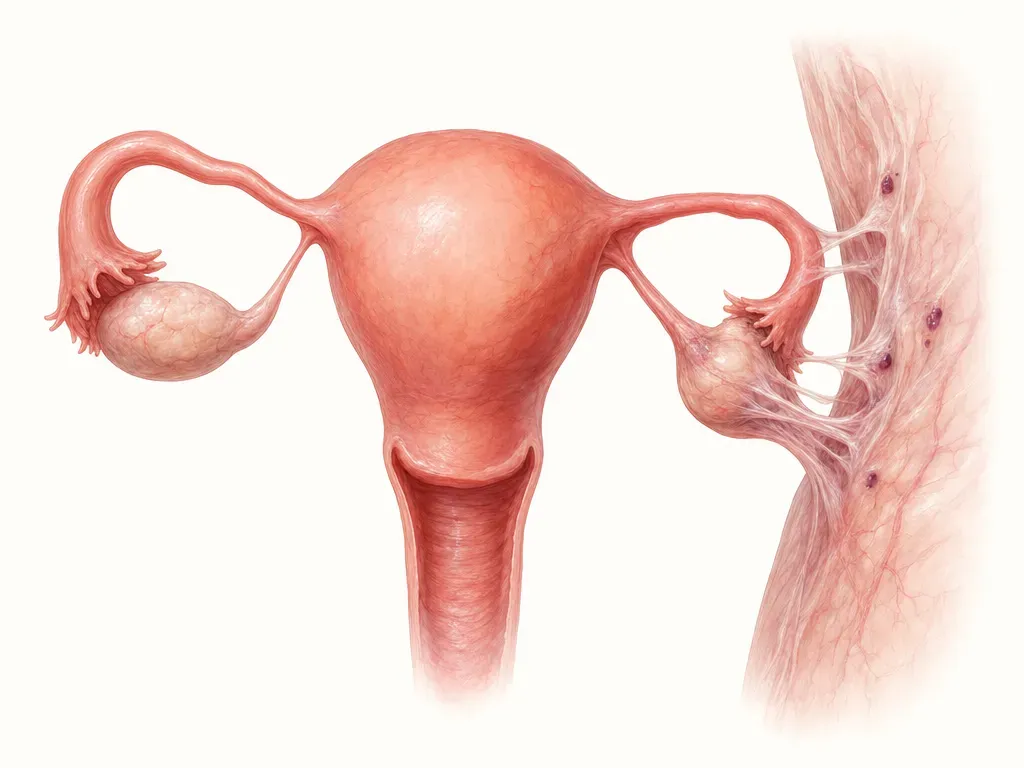
The terms “cul-de-sac obliteration” or “pouch of Douglas obliteration” describe closure of the space behind the uterus by adhesions and disease. This can affect surgical access and complexity, but the phrase alone does not specify the depth of bowel involvement.
Endometriomas, laterality, and what was treated
Endometriomas are ovarian cysts associated with endometriosis. Look for their size and laterality: unilateral means one ovary is involved, while bilateral means both are involved. Also check whether the report describes preserved ovarian tissue and the treatment performed on each ovary.
Keep separate what the surgeon observed, what was removed or otherwise treated, and what the laboratory confirmed in sampled tissue. Excision means tissue was cut out; ablation means tissue was destroyed in place; and cyst drainage is different from removal of the cyst wall. Pathology describes submitted samples, not every area of the pelvis.
The report may also document disease left in place and the reason, such as a need for additional expertise or a decision to avoid an unplanned organ procedure. If that distinction is unclear, ask the treating surgeon before assuming that all visible disease was removed.
Deep-disease mapping answers a different question
What imaging and anatomical maps can add
An rASRM stage summarizes surgical findings. Deep-disease mapping describes precisely where disease lies and its relationship to organs, information that may be needed before surgery.
Specialist transvaginal ultrasound or MRI can help assess the bowel, bladder, ureters, pelvic sidewall, and other sites. The ureters are the tubes carrying urine from the kidneys to the bladder. Imaging is less reliable for some superficial lesions, so a normal scan does not exclude all endometriosis.
A 2025 narrative review of classification systems used in people with endometriosis described #Enzian as an anatomical mapping framework that can incorporate imaging, while the AAGL classification emphasizes surgical complexity. These tools can complement rASRM rather than serving as mandatory replacements, and none substitutes for a separate symptom and fertility assessment.
What a stage cannot tell a surgical team
A stage alone does not tell a surgeon how deeply a bowel lesion extends, whether a ureter is narrowed, or how close disease lies to important nerves. Those details may affect consent, the planned procedure, and whether a colorectal surgeon or urologist should be involved.
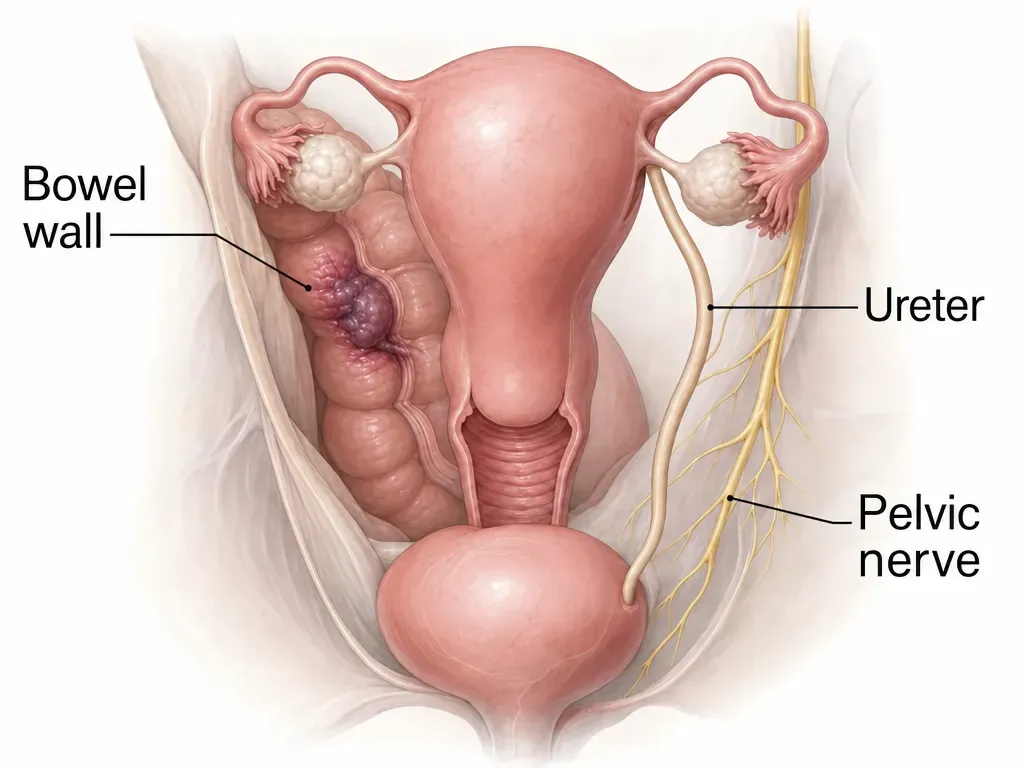
An imaging report may mention “kissing ovaries,” meaning the ovaries have been drawn together behind the uterus by adhesions. In a 2026 retrospective diagnostic-accuracy study of 252 women with surgically confirmed endometriosis, this sign was associated with bowel involvement and advanced-stage disease.
That finding is a planning flag, not a stand-alone diagnosis of bowel endometriosis. It should prompt a closer assessment of the surrounding anatomy, not an automatic recommendation for bowel surgery.
A low stage does not mean mild pain
Stage I endometriosis can cause substantial pain and disruption to daily life. The rASRM score does not reliably predict an individual’s pain intensity or guarantee how much relief treatment will provide.
Lesion location, pelvic floor muscle pain, adenomyosis, bladder pain syndrome, irritable bowel syndrome, and changes in nervous-system pain processing may all warrant consideration. These contributors can coexist with treatable endometriosis.
A 2026 systematic review of women with endometriosis and overlapping chronic pelvic pain conditions reported associations between higher Central Sensitization Inventory scores and persistent pain after surgery. However, this questionnaire captures broad symptoms and distress; it cannot diagnose a specific pain mechanism or determine that surgery will fail.
A broader assessment does not make the pain less real or rule out excision surgery. It can identify additional treatments, such as pelvic floor physical therapy or pain-focused care, that may be needed alongside treatment of lesions.
What Does Your Endometriosis Stage Mean for You?
Our specialists are here to help you understand your condition and explore your treatment options.
Schedule a ConsultationStages are not a timeline of inevitable progression
Stages I–IV are categories of anatomical findings, not steps that everyone will pass through. A stage recorded at surgery cannot establish when the disease began, how quickly it developed, or what will happen next.
A higher stage does not prove a predictable rate of progression. Likewise, a low stage does not establish that waiting is harmless or that new symptoms can be ignored.
Discuss new or changing pain, bowel or urinary symptoms, and fertility concerns with your own clinician. If observation is part of the plan, ask what should be monitored and which changes should trigger reassessment.
Fertility prospects need more than a stage
The fertility details a stage leaves out
Stage alone cannot tell you whether you will conceive without fertility treatment, need IVF, or benefit from surgery. Adhesions and ovarian disease can matter, but they are only part of the fertility assessment.
Your clinician should consider age, how long you have been trying, previous pregnancies, ovarian reserve, whether the fallopian tubes are open and functional, and semen parameters. Endometriomas, coexisting adenomyosis, other fertility factors, and your preferred timing also affect the options.
Ovarian-reserve tests, such as anti-Müllerian hormone testing and an ultrasound antral follicle count, help estimate the remaining egg supply and likely response to ovarian stimulation. They do not provide a yes-or-no answer about the possibility of pregnancy.
What a postoperative fertility index can add
The Endometriosis Fertility Index, or EFI, is a postoperative counseling tool that combines age, infertility duration, previous pregnancy, and surgical findings. It includes the surgeon’s assessment of the tubes, their egg-collecting ends, and the ovaries after treatment. It cannot be calculated from the stage label alone.
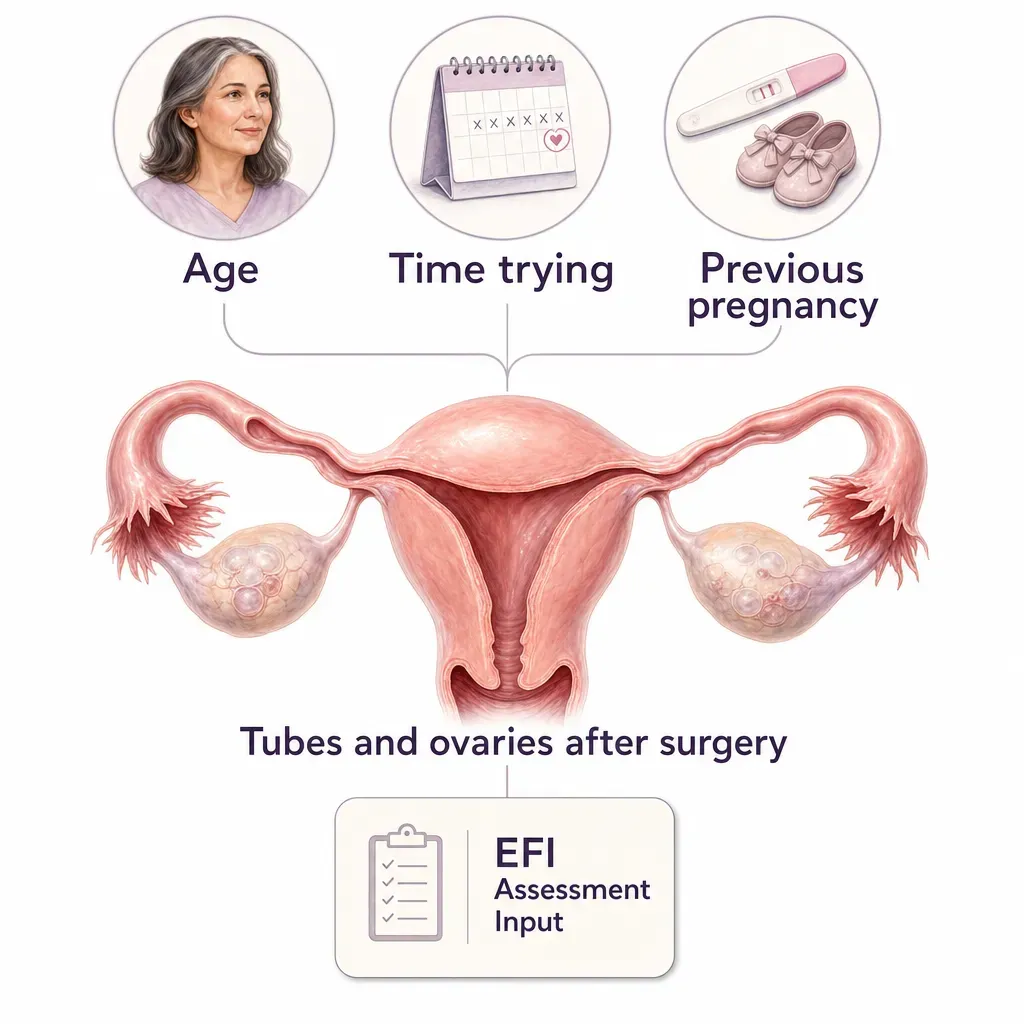
In a 2026 prospective cohort study of 72 women with endometriosis-associated infertility after laparoscopic surgery, 23 of 44 participants with an EFI of at least 7 achieved a clinical pregnancy within six months. Some participants received ovulation-inducing medication or intrauterine insemination, so this was not a rate of conception without treatment. Live birth outcomes were not reported.
The participants were a selected group with at least one open fallopian tube and partners with normal semen parameters. An EFI can support a discussion about trying without IVF and the timing of fertility treatment, but a high score is not a guarantee, and a low score does not establish that pregnancy is impossible.
Treatment choices depend on goals and findings, not stage alone
Treatment planning should separate symptom relief, pregnancy goals, and protection of an affected organ. A treatment that serves one goal may not serve another: hormonal suppression can help pain, for example, but is not suitable while actively trying to conceive.
Stage IV findings call for a tailored plan, not one standard treatment
Stage IV endometriosis treatment depends on which findings produced the score and what problems need attention. Someone with ovarian cysts and adhesions may face different choices from someone with narrowing of a ureter or bowel, even if both have the same stage.
For symptom control, options may include hormonal medication, pain treatment, pelvic floor therapy, and excision surgery, depending on symptoms, preferences, prior treatment, and anatomy. Significant pain with stage I findings also warrants a treatment discussion; a low score is not a reason to dismiss symptoms.
Suspected organ obstruction requires timely specialist assessment because symptoms alone may not reflect the degree of organ risk. By contrast, stage IV does not automatically require hysterectomy, removal of the ovaries, or bowel resection. Any proposed procedure should have a clear reason tied to your findings and goals.
Endometriomas and fertility goals can change the trade-offs
Endometrioma surgery can help with pain and cyst recurrence, but it can also reduce ovarian reserve, particularly when both ovaries require surgery. Before an ovarian procedure, discuss the expected benefit, the risk to healthy ovarian tissue, and whether fertility preservation should be considered.
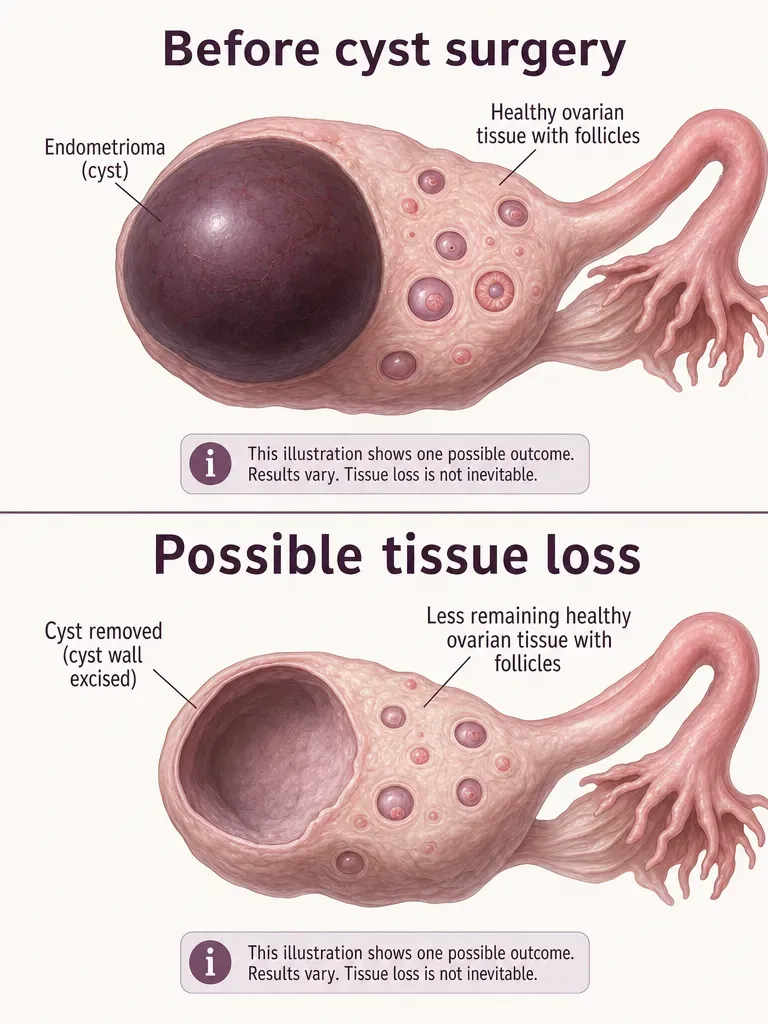
A 2026 clinical review of surgical fertility management in people with endometriosis summarized guidance against routine surgery before assisted reproduction solely to improve live birth rates. It also described guidance against routine cyst removal for asymptomatic endometriomas before IVF.
There can still be separate reasons to consider surgery, including substantial pain, difficulty accessing eggs during retrieval, or concerning findings that need further evaluation. The choice should account for age, ovarian reserve, prior ovarian surgery, and the likely delay before fertility treatment.
For selected people with stage I or II disease and infertility, treating lesions may improve the chance of pregnancy without IVF. That does not mean everyone should undergo surgery before fertility treatment, or that more extensive surgery produces better fertility outcomes. Ask how the proposed procedure compares with proceeding directly to fertility care for your circumstances.
Questions to take to your specialist
Bring your operative report, pathology results, available surgical photographs, and imaging reports to the discussion. A brief symptom history and a clear statement of your pregnancy goals can help connect the anatomical findings to decisions.
- What findings produced my stage, and was the rASRM point score recorded?
- Which sites were inspected, treated, or left untreated, and what did pathology confirm?
- Do my reports suggest deep bowel, bladder, ureter, or pelvic sidewall involvement?
- Would specialist ultrasound or MRI add information, and what would remain uncertain before treatment?
- Which symptoms might come from endometriosis, and which other pain contributors should be assessed?
- How do my pregnancy goals, ovarian reserve, tubal findings, and other fertility factors change the options? If I have had surgery, is an EFI available?
- What is the goal of each proposed treatment, what are its trade-offs, and what would the monitoring plan be if I defer it?
References
Ueno, Kaseki, Shiraishi et al.. Preoperative classification of endometriosis: a narrative review of revised American Society for Reproductive Medicine (r-ASRM), #Enzian, American Association of Gynecologic Laparoscopists (AAGL) 2021, and Numerical Multi-Scoring System of Endometriosis (NMS-E) systems. Gynecology and Pelvic Medicine. 2025. PMID: 42211905 PMCID: PMC13214995
Lepka, Lepka, Jędryka. Integrating the Central Sensitization Inventory (CSI) into Neuropelveological Practice: A Systematic Review of Endometriosis and Overlapping Pelvic Pain Syndromes. Journal of Clinical Medicine. 2026. PMID: 42452647 PMCID: PMC13362589
Mishra, Shubham, Malhotra. Validation of Endometriosis Fertility Index for the Prediction of Non-Assisted Reproductive Technology (ART) Pregnancy in Women With Endometriosis-Associated Infertility: A Prospective Cohort Study. Cureus. 2026. PMID: 42473530 PMCID: PMC13380972
Manu, Poenaru, Gheorghe et al.. Reproductive Outcomes Following Minimally Invasive Surgery for Deep Endometriosis: A Cohort Study. Journal of Clinical Medicine. 2026. PMID: 42513298 PMCID: PMC13412082
Aase, Khan. Endometriosis: surgical management for fertility enhancement. Frontiers in Endocrinology. 2026. PMID: 42558211 PMCID: PMC13437375
Ahmadbeigi, Padmehr, Shadjoo et al.. Diagnostic Accuracy of the Kissing Ovaries Sign on Transvaginal Ultrasound for Prediction of Bowel Endometriosis in Women with Surgically Confirmed Endometriosis. Journal of Reproduction & Infertility. 2026. PMID: 42633027 PMCID: PMC13498731
Petrovic, Keckstein, Mabrouk et al.. Proposals for the #Enzian addendum and update: an international expert survey for item generation. Facts, Views & Vision in ObGyn. 2026. PMID: 42533569 PMCID: PMC13575350
Li, Li, Yang et al.. Clinical Characteristics of Unilateral versus Bilateral Ovarian Endometriomas and Risk Stratification in Stage IV Disease Using the rASRM Score: A Retrospective Cohort Study from a Tertiary Medical Center. International Journal of Women's Health. 2026. PMID: 42802810 PMCID: PMC13616156
Przyśliwski, Siekierski, Pliszkiewicz et al.. Correlation Between the Age at Menarche, Time to Diagnosis, and Disease Severity Assessed Using the rASRM and #ENZIAN Classifications in Patients Diagnosed with Advanced Endometriosis. Journal of Clinical Medicine. 2026. PMID: 42881988 PMCID: PMC13665863
Quick Answers
Can endometriosis cause infertility and pelvic pain in your 20s?
Yes, endometriosis can cause chronic pelvic pain and fertility challenges in your late 20s. Pain can include severe period cramps, pain with sex, and bowel or bladder pain, though symptom severity doesn’t always match how much disease is present.
What is the AAGL endometriosis classification system?
The AAGL endometriosis classification system is a standardized way surgeons describe where endometriosis is found at surgery, how extensive it is, and how complex it appears. It is meant to better capture deeper disease that may affect surgical planning.
What does advanced adenomyosis mean?
Advanced adenomyosis usually means more extensive disease within the uterine muscle, often affecting a larger area or reaching deeper into the wall. There is no universally accepted staging system, and adenomyosis does not spread outside the uterus.
How fast does endometriosis grow?
Endometriosis doesn’t grow at one predictable rate: one person may have slow, relatively stable disease while another has lesions that progress faster. Most people first notice changing symptoms over months or years, rather than growth day to day.